10 Mistakes Mobile App Developers Should Avoid

In our modern digital age, mobile apps have become an integral part of our lives, enhancing communication, entertainment, and productivity. However, let’s face it; the process of developing mobile apps can be quite complex. Even the most talented developers can sometimes stumble upon common mistakes that can turn their hard work into a bit of a mess.

So, in this article, we’ll take a more humanized look at ten of these common pitfalls to avoid in mobile app development. You can also hire the best mobile app development company in Kolkata to avoid these mistakes.

Because nobody likes a laggy app that crashes every five minutes or has a user interface that looks like a maze!

So, let’s get started!

Avoid These 10 Mistakes in Mobile App Development 

Dive deep into the problems and, more importantly, figure out how to tackle them head-on. That way, you can ensure your apps perform like champions and deliver positive experiences to our users.

  • Insufficient Market Research

One of the most critical mistakes in mobile app development is not conducting thorough market research. Understanding your target audience, analyzing competitors, and identifying market trends are essential steps to build a successful app. You can do all these with the help of a leading mobile app development company in Kolkata. Without proper research, you may end up investing time and resources in an app that doesn’t cater to the users’ needs or lacks a unique selling proposition.

Conducting comprehensive market research involves gathering data on user preferences, pain points, and expectations. It also requires studying your competitors to identify gaps in the market and find opportunities to differentiate your app. By understanding the market landscape, you can align your app’s features and functionalities with the demands of the target audience.

  • Ignoring Cross-Platform Compatibility

Developers often focus on building an app for a single platform, such as iOS or Android, while neglecting cross-platform compatibility. Ignoring this aspect can limit your app’s reach and alienate potential users on other platforms. Embracing cross-platform development tools or adopting a hybrid approach can help you create an app that works seamlessly across various devices and operating systems. You can do it with the guidance of a top-notch mobile app development company in Kolkata.

Cross-platform development enables you to reach a broader audience, as users with different devices and operating systems can access your app. It also streamlines the development process, as you can share a significant portion of the codebase between platforms, reducing development time and cost.

  • Overloading the App with Features

While it may be tempting to include numerous features in your app, overloading it can lead to a cluttered and confusing user interface. Users prefer apps that are simple, intuitive, and focused on their core needs. Prioritize essential features and gradually introduce updates based on user feedback to avoid overwhelming your audience.

When designing your app, focus on the user’s main objectives and pain points. Develop features that cater to these needs and create a smooth user journey. User feedback and data analytics can help you identify which features are most valuable to your users and which ones might be unnecessary or underutilized.

  • Lack of App Security

Security is a paramount concern in mobile app development. Failing to implement robust security measures can expose user data to potential breaches and threats. Incorporating encryption, secure authentication, and regular security audits can safeguard your app and build trust with users.

Mobile apps often handle sensitive user information, such as personal data and payment details. It is crucial to implement encryption protocols to protect this data from unauthorized access. Additionally, user authentication methods, such as two-factor authentication, can add an extra layer of security. A leading mobile app development agency in Kolkata helps you build app security. 

  • Neglecting User Experience (UX)

A mobile app’s success is heavily reliant on its user experience. Neglecting UX design can lead to high bounce rates and low user retention. Focus on creating a visually appealing and intuitive interface, optimizing loading times, and ensuring smooth navigation throughout the app.

To enhance user experience, conduct usability testing to identify pain points and areas for improvement. Gather feedback from real users and iterate on your app’s design to address their needs effectively. Regularly update the app based on user feedback and changing trends to stay relevant and user-friendly.

  • Poor Testing and Quality Assurance

Skipping or conducting inadequate testing while mobile app development in Kolkata

can be detrimental to your app’s performance. Bugs, glitches, and crashes can frustrate users and harm your app’s reputation. Rigorous testing and quality assurance are indispensable to ensure your app functions flawlessly across various devices and scenarios.

Invest time and resources in both manual and automated testing to identify and rectify any issues before releasing your app to the public. Conduct testing on various devices, operating systems, and network conditions to simulate real-world scenarios. Regularly monitor app performance post-launch to address any emerging issues promptly.

  • Disregarding App Store Guidelines

When submitting your app to app stores, adhering to their guidelines is vital. Ignoring these guidelines can result in app rejection or removal from the store. Familiarize yourself with the specific requirements of each app store to ensure a smooth and successful submission process. A professional mobile app development Agency in Kolkata can help you in maintaining these guidelines in the submission.

Each app store, such as the Apple App Store and Google Play Store, has its set of guidelines and review processes. Make sure your app complies with these guidelines, including content policies, age restrictions, and design requirements, to avoid any delays or rejections during the approval process.

  • Ignoring User Feedback

Listening to user feedback is crucial for continuous improvement. Ignoring user comments and reviews can lead to stagnation and dissatisfaction among your user base. Regularly engage with users, gather feedback, and implement meaningful updates to enhance the app’s performance.

Encourage users to provide feedback within the app and respond promptly to their inquiries and concerns. Actively address their suggestions and pain points to demonstrate that you value their opinions. Building a community around your app can create a loyal user base that advocates for your app and provides valuable feedback.

  • Neglecting Post-Launch Support and Updates

Mobile app development is an ongoing process. Neglecting post-launch support and updates can cause your app to become outdated, leading to a decline in user engagement. Regularly release updates to address bugs, introduce new features, and adapt to changing user preferences. Professional mobile app development services in Kolkata include maintaining and updating apps after their launch. 

Post-launch support involves monitoring your app’s performance, responding to user feedback, and promptly addressing any issues that arise. Keep your app up to date with the latest mobile operating systems and device specifications to ensure compatibility and optimal performance.

User also read: The Impact of Big Data in Mobile App Development 


  • Lack of Marketing Strategy

Having a great app is not enough; you need a robust marketing strategy to reach your target audience effectively. A lack of marketing efforts can result in poor app visibility and limited downloads. Utilize social media, content marketing, and other promotional channels to create awareness and drive user acquisition. A leading mobile app development company in Kolkata can also provide you with professional digital marketing services.

Develop a comprehensive marketing plan that includes pre-launch promotion, app store optimization (ASO), and targeted advertising campaigns. Engage with potential users through social media platforms and relevant communities to create anticipation for your app’s release. Collaborate with influencers and app review websites to gain exposure and credibility.

HIre-the-Best-Mobile-App-Developer

Conclusion

Avoiding these ten common mistakes in mobile app development can significantly increase the chances of creating a successful and well-received app. By conducting thorough market research, prioritizing user experience, and implementing robust security measures, you can set your app up for success. You can take the help of a professional mobile app development company in Kolkata for a successful app development and app launch. Remember to continuously gather user feedback, adapt to the evolving market, and invest in marketing to ensure your app thrives in a highly competitive mobile app landscape.

Frequently Asked Questions

  • How can I conduct market research effectively?

Conducting market research involves identifying your target audience, analyzing competitors, and understanding market trends. Utilize online surveys, interviews, and analytics tools to gather relevant data.

  • What are the benefits of cross-platform development?

Cross-platform development allows your app to reach a broader audience by running on multiple platforms, saving development time and resources.

  • How often should I release app updates?

Regularly releasing updates is crucial to address bugs, introduce new features, and maintain user engagement. Aim for a balance between frequent updates and significant improvements.

  • How can I ensure my app’s security?

Implement strong encryption, secure authentication mechanisms, and conduct regular security audits to safeguard user data.

  • How do I effectively engage with users for feedback?

Encourage users to leave reviews and comments within the app, respond promptly to feedback, and consider implementing in-app surveys or feedback forms.

  • What are the key factors to consider when designing the app’s user interface?

When designing the app’s user interface, consider factors like simplicity, consistency, accessibility, and visual appeal. A clean and intuitive interface will enhance the user experience and drive user engagement. A leading mobile app development company in Kolkata considers this crucial factor while app building. 

  • How can I optimize my app for better app store visibility?

To optimize your app’s visibility in the app store, focus on app store optimization (ASO). Utilize relevant keywords, eye-catching app icons, and compelling app descriptions to attract potential users and improve your app’s search rankings.

  • What should I do if my app receives negative reviews?

Negative reviews are an opportunity for improvement. Respond to negative reviews professionally and constructively. Address the issues raised by users and communicate the steps you are taking to resolve them. Showing responsiveness and willingness to improve can turn negative feedback into positive experiences.

  • Is it essential to conduct beta testing before launching the app?

Yes, beta testing is crucial to identify and fix any bugs or issues before the app’s official launch. Engage beta testers to provide feedback on app usability and performance, allowing you to make necessary adjustments and improvements.

  • How can I promote my app to attract more users?

Promote your app through various marketing channels, such as social media, influencer collaborations, email marketing, and app review websites. Offer promotional discounts or incentives to encourage users to download and use your app.

 

12 Advantages of React Native Framework in Mobile App Development

Alright, fellow digital wanderers, let’s talk about the magic of mobile apps! 

They’re like little wizards granting our wishes – convenience, fun, and problem-solving all in one! 

And guess what? 

When developers create these wonders, they have some fancy frameworks to pick from, like React Native! 

So, let’s dive into the awesomeness of React Native for mobile app development, shall we?

Key Takeaways

  • React Native is a popular framework for mobile app development.
  • It offers numerous advantages, such as code reusability, cost efficiency, and reduced time to market.
  • React Native has a large developer community and provides access to third-party libraries.
  • It focuses on user interface and offers a framework for future development.
  • React Native allows the development of accessible apps and simplifies testing.
  • It is also compatible with React for Windows and is easy to learn.

What is React Native?

React Native is an open-source framework developed and unveiled by Facebook in 2015. It allows developers to build mobile applications using JavaScript and React, a popular JavaScript library for building user interfaces. React Native enables the development of cross-platform apps, meaning a single codebase can be used to create applications for both iOS and Android platforms.

How Does React Native Work?

Now that you have already read through this far and discovered what React Native exactly is, you must be wondering how React Native Works.

React Native works by using native components instead of web components. It uses native UI elements such as buttons, text inputs, and scroll views, which are compiled into native code. This approach ensures that the apps built with React Native have native-like performance and user experience.

What Are the Advantages of React Native

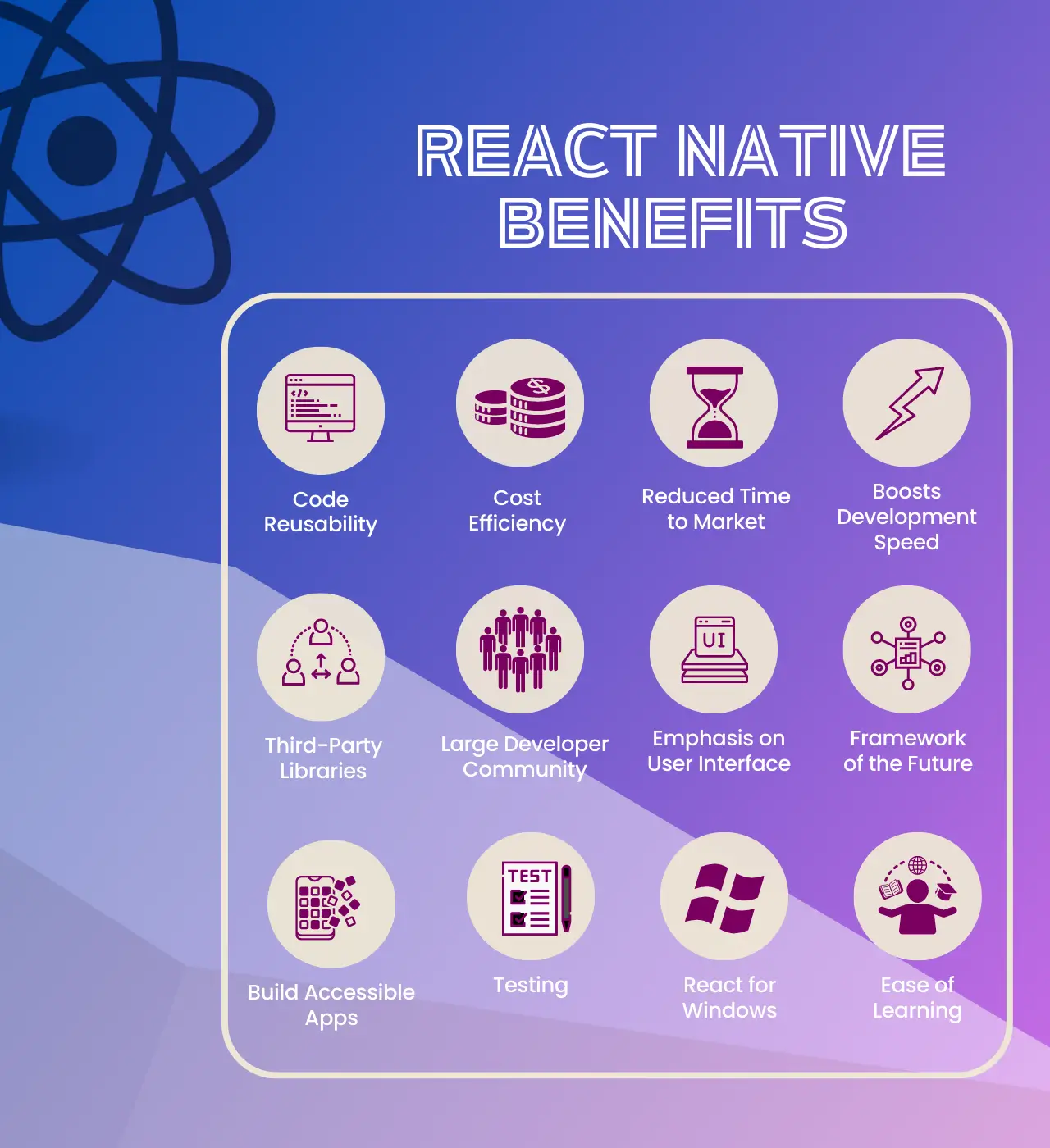
There are not one or two but several reasons why React Native has gained its contemporaneous popularity and been chosen over other frameworks. It is no sorcery, but the immaculate advantages of the framework are discussed below:

React-Native-Benefits


Code Reusability

One of the significant advantages of React Native is code reusability. Developers can write a single codebase in JavaScript and reuse it across multiple platforms. It saves time and effort as there’s no need to write separate code for iOS and Android. With React Native, developers can achieve maximum code sharing without compromising the app’s performance.

Cost Efficiency

By leveraging code reusability, React Native significantly reduces development costs. Businesses can save money by hiring a single development team that can work on both iOS and Android platforms. Moreover, both platforms can roll out updates and bug fixes simultaneously, reducing costs.

Reduced Time to Market

React Native offers a faster market time than traditional native app development. With a single codebase, developers can develop apps for multiple platforms simultaneously. It saves time, as building separate apps from scratch is unnecessary. Businesses can quickly launch their apps and gain a competitive edge in the market.

Boosts Development Speed

The hot-reloading feature of React Native allows developers to see the changes in real-time as they modify the code. It significantly speeds up the development process as developers can quickly iterate and test their changes without restarting the app. It enhances productivity and makes the development workflow more efficient.

Third-Party Libraries

React Native has a vast ecosystem of third-party libraries and components. Developers can leverage these libraries to add advanced functionalities to their apps. Whether it’s integrating push notifications, in-app purchases, or social media sharing, there’s likely a library available that simplifies the implementation. It saves development time and effort.

Large Developer Community

React Native has a thriving developer community. Developers can find extensive documentation, tutorials, and support from the community. They can seek help, share knowledge, and collaborate with other developers. The community-driven nature of React Native ensures that developers have access to the latest updates, bug fixes, and best practices.

Emphasis on User Interface

React Native places a strong emphasis on the user interface (UI). It provides a set of pre-built UI components optimized for mobile platforms. These components offer a native look and feel, enhancing the user experience. Developers can easily customize these components to match their app’s branding and design.

Framework of the Future

React Native has gained significant traction in the mobile app development community. Its popularity continues to grow, making it a framework of the future. As more businesses adopt React Native, developers with expertise in this framework will have abundant opportunities. Investing time in learning React Native can be a valuable career move.

Build Accessible Apps

Accessibility is a crucial aspect of app development. React Native provides built-in accessibility features that make it easier to build apps that people with disabilities can use. Developers can add features like voiceover support, large font sizes, and high-contrast themes to ensure their apps are inclusive and accessible to many users.

Testing

React Native simplifies the testing process. It provides tools and libraries that help developers write tests for their apps. Automated testing ensures the app functions as intended across different devices and screen sizes. React Native’s testing capabilities contribute to the overall quality and reliability of the developed apps.

React for Windows

React Native can be extended to develop Windows applications. By utilizing React for Windows, developers can leverage their existing React Native knowledge and codebase to build apps for Windows 10. It allows businesses to target a broader user base and expand their reach beyond mobile platforms.

Ease of Learning

Learning React Native is relatively easy, especially for developers familiar with JavaScript and React. The concepts and principles of React Native are similar to React, making the learning curve smoother. The comprehensive documentation and supportive community further simplify the learning process.

Leverage all the benefits with professional React Native development services.

Apps Built with React Native Framework

Below are some modern mobile apps built with React Native.

  • Instagram
  • Skype
  • Facebook Ads
  • SoundCloud
  • Uber Eats
  • Pinterest
  • Discord
  • Wix
  • Grasshopper
  • Airbnb
  • Tesla
  • Walmart

The Prosperity of React Native

Currently, Fabric, a dynamic, large-scale project, is being worked on by React Native. With Fabric’s support for the React Native framework and a hybrid JavaScript-based architecture, the goal is to make React Native seem less likely.

The three most crucial changes that can help React Native expand in the future are available to developers through the Fabric feature. The following changes are listed:

Ability to render in real-time

Async rendering capabilities in React Native will facilitate handling asynchronous data and provide various rendering priorities.

New Threading Model

Instead of requiring every UI change to work on three threads, the New Threading Model Fabric will allow its developers to call synchronously into JavaScript on any thread. It can withstand the strain on the primary thread without degrading.

Streamlined Bridge

Developers that are thinking about building a streamlined bridge to establish direct communication between JavaScript and native. It will also make it even easier to use different debugging tools.

Additionally, thanks to its unique advantages, the React Native framework consistently outperforms its rivals and has a bright future. 

The Future of React Native

As we look ahead, the future of React Native appears promising and exciting. React Native has already established itself as a popular framework for mobile app development, but its potential extends far beyond its current capabilities. With continuous improvements and advancements, React Native is expected to play a significant role in shaping the mobile app development landscape in the coming years.

One of the key areas of focus for the future of React Native is performance optimization. While React Native apps already offer native-like performance, efforts are being made to further enhance speed and responsiveness. The React Native team is actively working on reducing the bridge overhead, which will lead to smoother interactions and improved rendering speeds.

Additionally, the React Native community is working on incorporating more native modules and APIs to provide seamless access to device-specific functionalities. This will empower developers to create even more feature-rich and versatile applications.

The cross-platform capabilities of React Native will continue to be a major advantage in the future. As businesses strive to reach a wider audience across various platforms, React Native’s ability to share code between iOS, Android, and potentially other platforms will remain highly valuable.

Furthermore, the React Native ecosystem is poised to expand with the development of new tools, libraries, and extensions. This will facilitate easier integration of third-party services, analytics, and cloud-based solutions, streamlining the app development process and enabling developers to focus more on innovation and user experience.

The future of React Native also involves strengthening its compatibility with emerging technologies. As new devices and platforms enter the market, React Native is likely to adapt and support them, ensuring developers can stay at the forefront of innovation without having to learn entirely new frameworks.

Overall, the future of React Native is bright and dynamic. With its ever-growing community, active development, and continuous improvements, React Native is set to be a driving force in the world of mobile app development for years to come.

Finishing it up

Mobile app development with React Native offers numerous advantages. It provides code reusability, cost efficiency, and reduced time to market. React Native’s focus on UI, access to third-party libraries, and a large developer community contribute to its popularity. With React Native, developers can build accessible apps, simplify testing, and expand their reach to Windows platforms. Furthermore, React Native is easy to learn, making it an excellent choice for developers looking to build mobile apps efficiently. To know more about our services visit – www.excellisit.com


The Impact of Big Data in Mobile App Development

Since the use of mobile apps is exponentially increasing in several industries and businesses, they derive massive volumes of data. Thus, big data plays a crucial role in enhancing the performance, functionality, and user experience of mobile applications. 

Especially in the digital era of the 21st century, the utilization and impact of big data is becoming increasingly prevalent in mobile app development. 

Further, we will explore the impact of big data on mobile app development.

So, let’s get started!

What is Big Data?

Before delving into the impact of big data in mobile app development, it is essential to understand what big data actually means. Big data refers to the massive volumes of structured and unstructured data that organizations collect on a daily basis. This data is typically characterized by its high velocity, volume, and variety. Big data encompasses information from various sources, including social media platforms, sensors, user-generated content, and more. To make sense of this vast amount of data, advanced analytical techniques and tools are employed.

Here are some top international brands that have utilized Big Data to bring significant operational boosts to their organization:

  • Netflix
  • Walmart 
  • Capital One
  • Amazon
  • American Express
  • British Airways
  • Starbucks

How Does Big Data Work?

To fully grasp the impact of big data in mobile app development, it is important to comprehend the underlying processes involved. Big data work involves several key stages, including data collection, integration, handling, and analysis.

  • Data Collection

Data collection is the initial step in big data processing. It involves gathering data from various sources, such as user interactions, transactions, social media platforms, and IoT devices. Mobile apps are a major source of data collection, as they generate massive amounts of user-related information, including app usage patterns, preferences, and behaviors.

  • Integration

Once data is collected, it needs to be integrated into a central repository or data lake. The integration enables the consolidation of data from diverse sources, ensuring its accessibility for analysis. Through data integration, mobile app developers gain a comprehensive view of user activities, allowing for better insights and decision-making.

  • Data Handling

Data handling involves the management and preparation of collected data for analysis. This includes data cleaning, transformation, and organization. It is crucial to ensure data quality and reliability before proceeding to the analysis stage. Data handling techniques, such as data normalization and data deduplication, are employed to enhance the accuracy and consistency of the data.

  • Analysis

The final stage in the big data process is analysis. It involves applying advanced analytical techniques to extract valuable insights and patterns from the collected data. Various techniques, such as data mining, machine learning, and predictive analytics, are used to uncover hidden correlations and trends. The analysis of big data enables mobile app developers to make informed decisions and implement improvements to enhance user experiences.

Four V’s of Big Data

The impact of big data in mobile app development can be understood through the lens of the four V’s: volume, velocity, variety, and veracity.

  • Volume

The volume of data generated by mobile apps is enormous. With millions of users and their interactions being recorded, the amount of data collected can quickly become overwhelming. Big data technologies enable mobile app developers to handle and process this massive volume of data efficiently.

  • Velocity

Mobile apps generate data in real time. Users are constantly interacting with apps, generating streams of data that need to be processed and analyzed promptly. Big data solutions provide the necessary tools and infrastructure to handle the high velocity of data flow, allowing developers to derive insights and take immediate action.

  • Variety

Mobile app data comes in various formats and structures. It includes text, images, videos, sensor data, and more. Big data technologies are designed to handle diverse data types and structures, ensuring the integration and analysis of information from different sources.

  • Veracity

Veracity refers to the quality and reliability of the data. Mobile app data may contain inaccuracies, errors, or inconsistencies. Big data solutions offer mechanisms to verify and validate the data, ensuring its accuracy and credibility. By dealing with data veracity, developers can make more reliable decisions and create robust mobile applications.

What Makes Big Data a Significant Factor in Mobile App Development?

As the usage of mobile devices continues to soar and user expectations reach new heights, developers face the challenge of delivering highly tailored experiences that cater to individual preferences and behaviors. 

This is where big data steps in as a game-changer, empowering mobile app developers with the ability to analyze vast amounts of information, uncover patterns, and leverage data-driven decision-making to shape the future of app development.

Check out the significance of Big Data in mobile app development below:

  • Understanding Client Requirements

Big data plays a crucial role in understanding client requirements in mobile app development. By analyzing user interactions, preferences, and feedback, developers gain valuable insights into what features and functionalities are most desired. This enables them to create customized mobile apps that meet client expectations and deliver a superior user experience.

  • Understanding the Audience

Big data analytics helps mobile app developers gain a deep understanding of their target audience. By analyzing demographic data, user behavior patterns, and social media interactions, developers can tailor their apps to specific user segments. This understanding allows for more effective marketing strategies and user engagement, leading to increased app adoption and retention rates.

  • Social Media Analytics

Social media platforms generate a wealth of data that can be leveraged in mobile app development. Big data analytics enables developers to monitor social media conversations and sentiment analysis. By understanding user opinions, trends, and preferences, developers can adapt their apps to meet evolving market demands and provide a more personalized user experience.

  • Conversion of Sales

Big data analytics facilitates the identification of key factors that influence user conversion rates within mobile apps. By analyzing user behavior, purchase history, and product preferences, developers can optimize their apps to enhance the conversion of sales. This includes implementing personalized recommendations, targeted advertising, and pricing strategies that resonate with users.

  • Personalization

Personalization is a significant factor that a mobile app development company adopts for mobile app success. Big data enables developers to create personalized experiences by analyzing user data and behavior. This includes tailoring content, recommendations, and notifications to match individual preferences and needs. Personalization enhances user engagement and satisfaction, leading to increased app usage and customer loyalty.

  • Connected Devices

The rise of the Internet of Things (IoT) has resulted in a proliferation of connected devices. Big data analytics allows mobile app developers to integrate data from these devices and create innovative applications. By analyzing data generated by IoT devices, such as wearables or smart home devices, developers can enhance app functionalities and provide users with seamless and connected experiences.

  • User Experience Analysis

Big data analysis provides valuable insights into user experiences within mobile apps. By tracking user interactions, app usage patterns, and performance metrics, developers can identify areas for improvement. This includes optimizing app navigation, reducing loading times, and eliminating usability issues, resulting in an enhanced user experience.

  • Real-Time Data Availability

Big Data helps companies build premium mobile app development services for their clients. One of the most significant impacts of big data in mobile app development is real-time data availability. With big data technologies, developers can analyze data as it is generated, enabling them to make immediate decisions and take proactive actions. Real-time data availability enhances the responsiveness and agility of mobile apps, ensuring a seamless user experience.

  • Customized Marketing Campaigns

Big data analysis allows for the creation of customized marketing campaigns within mobile apps. By leveraging user data, developers can tailor marketing messages, offers, and promotions to individual users. This targeted approach increases the effectiveness of marketing campaigns, leading to higher user engagement and conversion rates.

Finishing it up

In conclusion, big data has revolutionized the field of mobile app development. Its impact is felt across various stages, from understanding client requirements to creating personalized experiences and optimizing app performance. By leveraging the four V’s of big data, mobile app developers can harness the vast amounts of data generated by apps and transform it into valuable insights and actions. With the continuous advancement of big data technologies, the impact on mobile app development is only expected to grow, leading to more innovative, user-centric, and successful applications in the future.


Django vs. Node.js: Which One to Choose for Your Website?

As a developer, one question must be striking your head all the time and that is “What to learn next?”

New technologies are being introduced and replacing the old ones every now and then. In the ever-growing web development industry, every skilled web developer must keep themselves upskilled with the latest technologies. 

So, whenever it comes to choosing which back-end framework you should learn and upgrade yourself with, the choices are endless. This article has a detailed discussion and comparison between the two most popular backend development frameworks, Django vs. Node.js to make your choice easy.

So let’s delve in.

Table of context

When it comes to developing a website, choosing the right technology stack is crucial for its success. Among the popular options available, Django and Node.js stand out as powerful frameworks. Both have their unique features and advantages, but understanding their differences can help you make an informed decision. Here, we will compare Django vs. Node.js based on various parameters to help you determine which one is the best fit for your website development needs.

Summary: Django vs. Node.js: Which one to choose for your website? This article compares the key features, advantages, and disadvantages of Django and Node.js. It explores their differences in parameters like architecture, language, scalability, security, and community support. Make an informed decision based on your project requirements.

Understanding Django

Django is a high-level Python web framework known for its simplicity and robustness. It follows the Model-View-Controller (MVC) architectural pattern, making it easy to organize and manage complex web applications. Django emphasizes reusability and follows the “Don’t Repeat Yourself” (DRY) principle, enabling developers to build applications efficiently.

Key features of Django

Here are some of the most significant key features of Django:

  • Batteries included 

Django provides a comprehensive set of built-in tools and libraries, covering everything from database access to authentication and URL routing. This feature saves development time and effort.

  • Object-Relational Mapping (ORM) 

Django’s ORM simplifies database interactions by allowing developers to work with database objects directly in Python code, without writing SQL queries manually.

  • Admin interface 

Django offers an automatic admin interface, which can be customized to provide a user-friendly interface for managing application data.
Not an expert in Django? Hire a Django developer in India from the most reliable web development company.

Advantages of Django

Check out the advantages of Django:

  • Rapid development

Django’s high-level abstractions and built-in components enable rapid application development. It provides a solid foundation for building scalable and maintainable web applications.

  • Python ecosystem

Django leverages the vast Python ecosystem, providing access to numerous libraries and packages that can enhance the functionality of your web application.

  • Security

Django incorporates security features by default, including protection against common web vulnerabilities like SQL injection and cross-site scripting (XSS).

Disadvantages of Django

Check out the disadvantages of Django:

  • Learning curve

Django follows specific conventions and has a learning curve, especially for beginners. Understanding its concepts and best practices might require some initial effort.

  • Performance

While Django is highly efficient, it might not be the best choice for extremely high-traffic websites due to its synchronous nature.

Understanding Node.js

Node.js is an open-source JavaScript runtime environment that allows developers to build scalable and efficient network applications. It uses an event-driven, non-blocking I/O model, making it ideal for handling concurrent requests and real-time applications.

Key features of Node.js

Below are the key features of Node.js:

  • Asynchronous programming

Node.js uses non-blocking I/O operations, enabling it to handle multiple requests simultaneously. This feature makes Node.js highly scalable and efficient.

  • Vibrant package ecosystem

Node.js has a vast collection of open-source packages available through the npm (Node Package Manager) registry. These packages provide additional functionality and simplify development tasks.

  • Single-threaded, event-driven architecture

Node.js follows a single-threaded event loop model, allowing it to handle multiple connections concurrently. It excels in building real-time applications that require frequent data updates.

Not an expert in Node.js? Hire a Node.js developer in India from a leading web development company.

Advantages of Node.js

Here are the advantages of Node.js:

  • High performance

Node.js’s non-blocking architecture and event-driven model result in excellent performance, making it suitable for handling a large number of concurrent connections.

  • JavaScript proficiency

If you already have JavaScript knowledge, transitioning to Node.js becomes easier. You can reuse your existing JavaScript skills to develop both front-end and back-end applications.

  • Real-time applications

Node.js is well-suited for building real-time applications, such as chat applications, collaboration tools, social media platforms, and streaming applications. Its event-driven nature allows for seamless communication and data exchange in real time.

Disadvantages of Node.js

Check out the disadvantages of Node.js:

  • Callback-based programming 

Node.js heavily relies on callbacks, which can lead to complex and nested code structures. Managing asynchronous operations and handling errors effectively can be challenging for developers.

  • Limited CPU-intensive tasks

While Node.js excels in handling I/O-intensive tasks, it may not be the best choice for CPU-intensive operations. Since Node.js runs on a single thread, CPU-bound tasks can block the event loop and affect the application’s performance.

Basic comparison between Django and Node.js

Below is the basic comparison between Django vs. Node.js:

Parameters Django Node.js
Programming language Python JavaScript
Community size Large Large
Scalability High Mid-range
Security High Medium
Performance Mid-range High
Learning curve Easy to learn for novices due to the straightforward Python. Easy to learn but with possibilities of further challenges for novices.

Django vs. Node.js: Differences between these 2 frameworks

When choosing between Django and Node.js, several parameters come into play. Let’s explore the key aspects where these frameworks differ:

  • Key Aspect

Django: Django is a full-fledged web framework written in Python, offering a comprehensive set of tools and features for building complex web applications.

Node.js: Node.js is a JavaScript runtime environment focused on building scalable network applications, leveraging an event-driven architecture.

  • Language on which the framework is developed on

Django: Developed in Python, a versatile and widely adopted programming language known for its readability and ease of use.

Node.js: Developed in JavaScript, a popular programming language that runs on the client side as well. Using the same language on the front end and back end can streamline development.

  • Architectural pattern followed

Django: Django follows the Model-View-Controller (MVC) architectural pattern, emphasizing the separation of concerns and code organization.

Node.js: Node.js follows a non-blocking, event-driven architecture, allowing for efficient handling of concurrent requests through callbacks and event loops.

  • Complexity

Django: Django provides a comprehensive set of features out-of-the-box, which can make it more suitable for complex web applications. However, this also adds some complexity to the learning curve.

Node.js: Node.js follows a minimalist approach and allows developers to choose the specific libraries and modules they need. This flexibility can simplify the development process, especially for smaller projects.

  • Cost Efficiency

Django: Django is an open-source framework, which means there are no licensing costs involved. It utilizes the Python ecosystem, which offers a wide range of open-source libraries and tools.

Node.js: Node.js is also open-source, making it cost-effective for development. The npm registry provides a vast collection of free and reusable packages, further reducing development costs.

  • Security

Django: Django emphasizes security and provides built-in features to mitigate common web vulnerabilities. It encourages secure coding practices and offers protection against various attacks.

Node.js: Node.js’s security largely depends on the developers’ implementation. While it provides modules and best practices for secure coding, developers need to be diligent in handling security aspects.

  • Applications

Django: Django is well-suited for building content-heavy applications, such as social networking sites, e-commerce platforms, and data-driven web applications.

Node.js: Node.js is ideal for building real-time applications, including chat applications, collaborative tools, and streaming platforms that require frequent data updates and real-time communication.

  • Scalability

Django: Django can handle high-traffic websites efficiently, but its synchronous nature might limit scalability in certain scenarios. Additional techniques, such as load balancing, can help improve scalability.

Node.js: Node.js’s non-blocking I/O model enables it to handle a large number of concurrent connections, making it highly scalable by default.

  • Reputation

Django: Django has a strong reputation in the web development community due to its stability, maturity, and widespread adoption. It is trusted by many large-scale applications and companies.

Node.js: Node.js has gained significant popularity in recent years and has a vibrant and active community. It is widely used by startups, small-scale applications, and companies requiring real-time functionality such as Netflix, LinkedIn, and PayPal.

  • Full Stack Web Development

Django: Django provides a complete set of tools for full-stack web development, including the backend, frontend, and database integration. It promotes a structured approach to building web applications.

Node.js: Node.js can be used for full-stack web development, but it primarily focuses on the backend. It seamlessly integrates with JavaScript frameworks like React or Angular for front-end development.

  • Stability

Django: Django is known for its stability and maturity. It has been around for over a decade, and its extensive documentation and community support ensure a reliable and stable development environment.

Node.js: Node.js has seen rapid growth and development in recent years. While it offers great flexibility and new features, it may have occasional updates and changes that require developers to adapt.

  • Community Support

Django: Django has a large and active community of developers who contribute to its continuous improvement. The community provides extensive documentation, tutorials, and support forums, making it easier for developers to find assistance.

Node.js: Node.js has a thriving community that constantly contributes new packages, tools, and frameworks. The community-driven development ensures a wealth of resources and support for developers.

Final Verdict

After a thorough comparison between Django vs. Node.js, we can see that choosing between these frameworks depends on your specific requirements and project goals. Here’s a summary of their key attributes:

Choose Django if you prefer a full-fledged, feature-rich framework with a focus on rapid development, robustness, and security. It’s suitable for complex web applications and projects that require a mature and stable environment.

Choose Node.js if you prioritize scalability, real-time functionality, and non-blocking, event-driven architecture. It’s ideal for building lightweight, high-performance applications with a strong emphasis on asynchronous programming.

Ultimately, the choice between Django and Node.js should be based on your familiarity with the programming languages (Python vs. JavaScript), the project’s requirements, and the expertise of your development team. Consider factors such as project complexity, performance needs, scalability, and the availability of relevant libraries and tools.

With the right understanding of their differences and considering your specific needs, you can confidently select either Django or Node.js to build a robust and efficient website.

Finishing it up

After a detailed Django vs. Node.js battle, we learnt when choosing between them for your website development, it’s essential to assess their features, advantages, disadvantages, and differences in various parameters. Both frameworks offer unique strengths and cater to different use cases.

Remember to evaluate the complexity of your project, scalability requirements, development cost, security needs, and the expertise of your development team. By making an informed decision based on your specific requirements, you can ensure the successful development of your website.


TTFB & INP: Explore Google’s Core Web Vitals of 2023

In today’s digital landscape, website performance plays a crucial role in attracting and retaining users. While Google’s performance metrics are ever-changing, it has introduced its latest core web vitals– TTFB and INP. 

In this article, we will delve into the definition, importance, measurement, and optimization of TTFB and INP.

So, let’s jump into it!

Key Takeaway

In a nutshell, TTFB (Time to First Byte) and INP (Input Delay) are vital metrics for website performance. TTFB measures server response time, while INP focuses on user interaction delays. Optimizing both ensures faster loading, improved user experience, and higher search engine rankings.

Definition of TTFB (Time To First Byte)

TTFB, or Time to First Byte, is the duration between a user’s request for a webpage and the moment the first byte of data is received from the server. It includes the time taken for the server to process the request, generate the webpage, and send it back to the user’s browser. TTFB is measured in milliseconds (ms) and is a critical factor in determining the initial load time of a webpage.


Importance of TTFB

TTFB plays a crucial role in user experience and search engine optimization. A fast TTFB contributes to a snappy and responsive website, resulting in a positive user experience. Users expect websites to load quickly, and a delay in TTFB can lead to frustration and increased bounce rates. Moreover, search engines consider TTFB as one of the factors when ranking web pages. A slow TTFB can negatively impact a website’s search engine visibility and organic traffic.

What is Considered a Good TTFB

A good TTFB is typically below 200 milliseconds. However, it’s important to note that the acceptable TTFB may vary depending on the complexity of the website, the user’s geographical location, and the available network infrastructure. It’s recommended to aim for the lowest TTFB possible to ensure optimal performance.

How to Measure TTFB

Measuring TTFB requires specialized tools and techniques. One common method is to use web performance monitoring tools that provide detailed metrics, including TTFB. These tools simulate user requests and measure the time it takes for the server to respond with the first byte. By monitoring TTFB regularly, website owners and administrators can identify performance bottlenecks and take necessary optimization measures.

How to Lower TTFB

Reducing TTFB involves various optimization strategies. Here are some effective techniques:

  • Optimize server configuration

Fine-tune server settings, such as caching, compression, and resource allocation, to improve response times.

  • Use a content delivery network (CDN)

CDNs cache website content in multiple server locations worldwide, reducing the physical distance between users and servers, thereby improving TTFB.

  • Enable caching

Implement browser and server-side caching to store frequently accessed content, reducing the need for generating webpages from scratch.

  • Optimize database queries

Ensure efficient database queries by using indexes, optimizing table structures, and minimizing unnecessary database operations.

  • Minimize network round trips

Reduce the number of HTTP requests by combining and compressing CSS and JavaScript files.

Not an expert? Connect to the best digital marketing company in Kolkata

Definition of INP

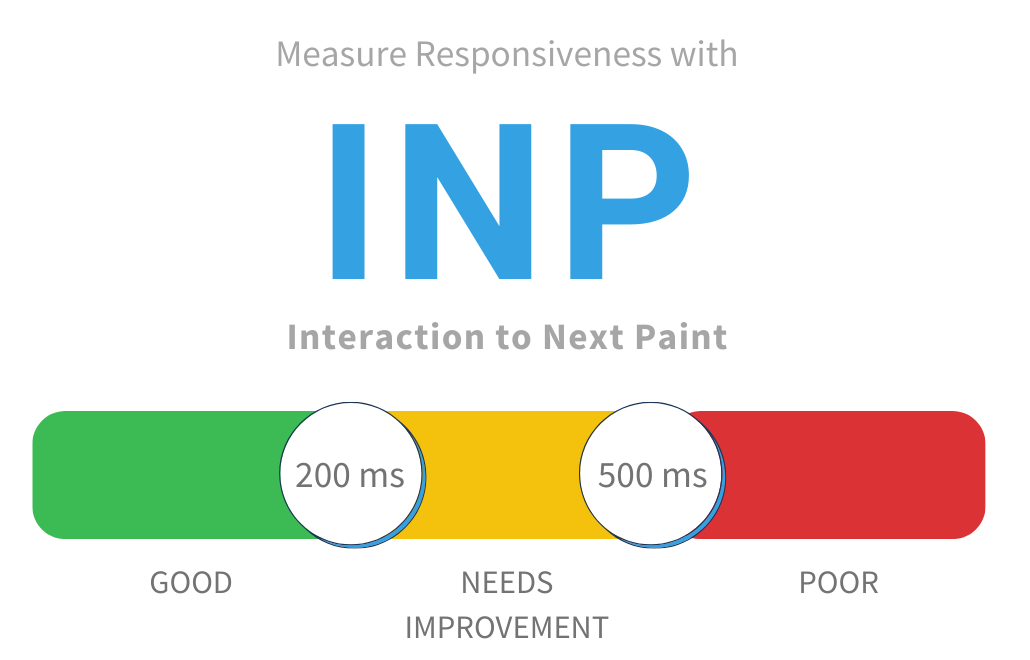
Apart from TTFB, Input Delay (INP) is another crucial metric that affects user experience. INP is a pending Core Web Vital that will replace FID in March 2024. INP refers to the time between a user input, such as clicking a button or selecting an option, and the response or feedback received from the website. It includes the time taken for the browser to process the user’s input and render the corresponding changes on the webpage.

Interaction to Next Paint (INP)

Benefits of INP

A low INP contributes to a seamless and interactive user experience. When users interact with a website, they expect immediate feedback. A high INP can result in delays, unresponsive UI elements, and overall frustration. Optimizing INP leads to improved user satisfaction, increased engagement, and higher conversion rates.

What is Considered a Good INP

An ideal INP should be under 200 milliseconds to provide a smooth and responsive user experience. However, similar to TTFB, the acceptable INP may vary depending on factors such as website complexity and the nature of user interactions. Striving for a low INP is essential for delivering a highly interactive website.

How to Measure INP

Measuring INP requires tools that capture user interactions and the corresponding response times. Performance monitoring tools equipped with user session recording capabilities can track input events and measure the time it takes for the website to respond. Analyzing INP data helps identify areas where improvements can be made to reduce delays and enhance interactivity.

How to Optimize INP

To optimize INP, consider the following strategies:

  • Prioritize critical rendering

Ensure that the most important content and interactive elements are rendered and respond quickly to user inputs.

  • Minimize JavaScript execution time

Optimize JavaScript code by reducing its complexity, removing unnecessary libraries, and leveraging asynchronous loading techniques.

  • Optimize event handlers

Review event handling code to ensure it is efficient and doesn’t introduce unnecessary delays in responding to user inputs.

  • Optimize CSS rendering

Minimize render-blocking CSS and use techniques like lazy loading and critical CSS to speed up the rendering process.

  • Leverage browser capabilities

Utilize modern browser features and APIs to enhance interactivity and responsiveness, such as prefetching resources and utilizing service workers.

Conclusion


In conclusion, TTFB and INP are critical performance metrics that significantly impact user experience and website success. A fast TTFB ensures quick webpage loading, while a low INP provides seamless interactivity. By understanding these metrics, measuring them accurately, and implementing optimization strategies, website owners and administrators can deliver exceptional user experiences, improve search engine rankings, and drive higher user engagement and conversions.


The Journey from Crawling to Ranking: Unraveling the Search Engine Algorithm

Welcome to the fascinating world of search engine algorithms, where websites compete and ultimately strive to rank high in search engine results. Search engine algorithms are constantly evolving to keep pace with the dynamic nature of the digital landscape. With advancements in technology and changes in user behaviour, search engines continuously refine their algorithms to deliver more accurate, relevant, and high-quality search results. 

Understanding and adapting to these algorithmic changes is essential for businesses and website owners to maintain visibility, attract organic traffic, and stay ahead in the competitive world of online search. In this article, we will embark on how search engines crawl and index according to the algorithm and understand the steps involved in going from crawling to ranking. 

The Basics of Search Engine Crawling


What is Search Engine Crawling?

Search engine crawling is the initial step in the process of indexing web pages. It involves search engine bots, also known as spiders or crawlers, systematically visiting websites to discover and gather information about their content. These bots follow links from one page to another, analyzing the content and storing it in a vast index.

How Do Search Engine Crawlers Work?

Search engine crawlers operate by following hyperlinks found on web pages. They start with a seed URL, such as a homepage, and then recursively navigate through the website by extracting links and visiting each new page. As they crawl, they analyze the page’s content, including text, images, and metadata, to gain insights into its relevance and quality.

The Role of Sitemaps in Crawling

Sitemaps play a crucial role in search engine crawling. A sitemap is a file that provides a list of all the pages on a website, helping search engine crawlers navigate and discover content more efficiently. By submitting a sitemap to search engines, website owners ensure that their pages are indexed and crawled more effectively.

Understanding Search Engine Indexing


What is Search Engine Indexing?

Search engine indexing is the process of storing and organizing the information gathered during crawling. The indexed data serves as a reference for search engines to retrieve relevant results when users perform queries.

Generally, web spiders do the crawling on a particular interval of time. However, you can manually ask the search engine to crawl your website through Google Search Console if your website does not index.

How Does Search Engine Indexing Work?

After search engine crawlers gather information about web pages, they store it in an index. This index contains a vast amount of data about the content, structure, and relevance of each page. When a user enters a search query, the search engine retrieves relevant pages from its index and ranks them based on various factors.

The Importance of On-Page Optimization

To ensure successful indexing, it is crucial to optimize web pages for search engines. On-page optimization involves techniques such as using relevant keywords, creating informative meta tags, and structuring content using appropriate HTML elements. By implementing these best practices, website owners can enhance the visibility and relevance of their pages in search results.

Unraveling the Search Engine Algorithm


How Do Search Engines Rank Websites?

Search engine ranking algorithms are complex and multifaceted, considering numerous factors to determine the order in which web pages appear in search results. While the exact algorithms are closely guarded secrets, search engines aim to provide the most relevant and high-quality results to users.

Factors such as keyword relevance, backlinks, user experience, and content quality all play significant roles in determining website rankings.

The Role of Keywords in SEO

Keywords are the foundation of SEO. They are words or phrases that users enter into search engines to find information. By strategically incorporating relevant keywords into website content, meta tags, and headings, website owners can increase their chances of ranking higher in search results.

However, it is essential to use keywords naturally and avoid keyword stuffing, as search engines prioritize user experience and content quality.

The Power of Backlinks

Backlinks, also known as inbound links, are links from external websites that point to a specific page on a website. Search engines consider backlinks as votes of confidence in a page’s authority and relevance. The more high-quality backlinks a page receives, the greater its chances of ranking well. Building a strong backlink profile through outreach, content creation, and networking can significantly impact a website’s search visibility.

The Impact of User Experience

User experience (UX) plays a crucial role in search engine optimization. Search engines strive to deliver the best possible results to users, and they consider factors such as page loading speed, mobile-friendliness, and overall usability when ranking websites. Optimizing for UX not only improves search rankings but also enhances the overall satisfaction of website visitors.

Creating High-Quality Content

Content quality is paramount in SEO. Search engines favour websites that provide valuable, relevant, and well-structured content. It is essential to create original, engaging, and informative content that meets the needs of the target audience. Regularly updating and expanding content also signals to search engines that the website is active and relevant.

User Read Also: How Does A Digital Marketing Company Help Track Campaign Success?

The Evolving Nature of SEO

Search engine algorithms are constantly evolving to provide better search results and combat spammy practices. Staying up to date with the latest trends and best practices in SEO is crucial for website owners and digital marketers. It requires continuous learning, adapting strategies, and monitoring performance to maintain or improve search visibility.

The Role of Analytics in SEO

Analytics tools provide valuable insights into website performance, user behaviour, and SEO efforts. By analyzing data such as organic traffic, bounce rate, and conversion rates, website owners can identify areas for improvement and make data-driven decisions to optimize their SEO strategies.

Local SEO and Mobile Optimization

Local SEO is essential for businesses targeting customers in specific geographic locations. Optimizing for local search involves strategies such as creating location-specific content, claiming and optimizing Google My Business listings, and obtaining local citations.

Additionally, with the increasing use of mobile devices for internet browsing, mobile optimization has become crucial for SEO success. Websites that are mobile-friendly and provide a seamless experience on smartphones and tablets tend to rank better in mobile search results.

Hire a Search Engine expert from a top-notch digital marketing company in Kolkata and ace the algorithms.

Grow your business with us

Conclusion

Search engine algorithms and SEO practices are complex, but understanding their fundamentals is crucial for online success. By focusing on crawling, indexing, on-page optimization, keywords, backlinks, user experience, content quality, and staying up to date with evolving trends, website owners can improve their search visibility and attract organic traffic. Implementing effective SEO strategies and analyzing data through analytics tools can provide valuable insights for continuous improvement. Embracing the world of search engine algorithms opens up opportunities to connect with a wider audience and achieve digital success.


10 Reasons Why a Business Should Hire a Mobile App Development Company

In today’s digital age, mobile devices have become an integral part of our lives. They have revolutionized the way we communicate, work, and access information. As a result, businesses need to adapt to this changing landscape and leverage the power of mobile technology to stay competitive. While the mobile app is increasingly adding up to our daily convenience by letting businesses offer an array of services, every business is launching its app.

A mobile app development company in Kolkata can be instrumental in several different ways This article will explore ten compelling reasons why businesses should consider hiring a mobile development company to create their mobile applications.

10 Reasons to Choose a Mobile Development Company

When it comes to creating a successful mobile application, choosing the right mobile development company can make all the difference. With their expertise, experience, and specialized skills, these companies offer numerous advantages that can propel your business forward in the digital landscape. Check out the 10 compelling reasons why selecting a mobile development company is the smart choice for businesses aiming to harness the power of mobile technology.

  • Improved User Experience

A mobile development company that specializes in creating user-friendly and intuitive mobile applications. They understand the importance of providing a seamless user experience that keeps customers engaged and satisfied. By hiring a professional company, businesses can ensure that their mobile app is designed with user-centric features, responsive layouts, and easy navigation, resulting in enhanced user satisfaction and increased customer retention.

  • Access to Expertise

A mobile app development company in Kolkata consists of experienced professionals who possess a deep understanding of the latest mobile technologies and trends. They have the expertise to transform a business idea into a fully functional and visually appealing mobile application. These experts stay updated with industry best practices, ensuring that the app is developed using the most advanced techniques, resulting in a high-quality product. 

  • Cost-Effective Solution

Contrary to popular belief, hiring a mobile development company can be a cost-effective solution for businesses. Developing an in-house mobile app development team requires significant investment in hiring, training, and infrastructure. On the other hand, outsourcing the development to a specialized company eliminates these costs and provides access to a skilled team at a fraction of the price, saving both time and money.

  • Time Efficiency

Time is of the essence in today’s fast-paced business environment. Mobile development companies are equipped with the necessary resources and streamlined processes to deliver projects within the agreed timelines. Their experience and expertise allow them to efficiently handle various aspects of app development, such as design, coding, testing, and deployment, ensuring timely delivery of the final product.

  • Scalability and Flexibility

A mobile app development company in Kolkata offers scalability and flexibility to accommodate the evolving needs of a business. As the business grows, the app may require updates, additional features, or integrations with other systems. Mobile development companies can easily adapt to these changes and provide ongoing support and maintenance, ensuring that the app remains up-to-date and aligned with the business goals.

  • Optimized Performance

Mobile development companies focus on optimizing the performance of the mobile applications they develop. They utilize efficient coding practices, implement performance monitoring tools, and conduct thorough testing to ensure that the app functions smoothly across various devices and operating systems. Optimized performance leads to faster load times, improved responsiveness, and a seamless user experience.

  • Integration with Existing Systems

For businesses that already have existing systems in place, such as customer relationship management (CRM) or enterprise resource planning (ERP) systems, integrating these systems with a mobile application is crucial. Mobile development companies have experience in integrating different software solutions, allowing businesses to streamline their operations, enhance productivity, and provide a unified experience to their users.

  • Market Reach and Brand Visibility

Mobile applications have the potential to reach a vast audience and significantly increase brand visibility. With billions of smartphone users worldwide, businesses can tap into this market by offering a mobile app that provides value to their target audience. A mobile app development company in Kolkata can help businesses create an engaging app that aligns with their brand identity, effectively promoting their products or services and reaching a wider customer base.

  • Competitive Advantage

In today’s competitive business landscape, staying ahead of the competition is crucial. By investing in a mobile application developed by a professional mobile development company, businesses gain a competitive edge. A well-designed and feature-rich app can attract customers, improve brand perception, and differentiate the business from its competitors.

  • Enhanced Data Security

Data security is a critical concern for businesses, especially when dealing with sensitive customer information. Mobile development companies understand the importance of safeguarding data and prioritize security measures during app development. They implement industry-standard encryption techniques, secure authentication protocols, and data storage practices to protect user data from unauthorized access and cyber threats. By hiring a development company, businesses can ensure that their mobile app is built with robust security measures, instilling trust and confidence in their users.

Conclusion

In conclusion, hiring a mobile app development company in Kolkata offers numerous advantages for businesses seeking to harness the power of mobile technology. From improved user experience and access to expertise to cost-effectiveness and competitive advantage, businesses can leverage the skills and experience of these specialized companies to create mobile applications that drive growth, enhance brand visibility, and provide a seamless experience for their customers.


How Does A Digital Marketing Company Help Track Campaign Success?

In the ever-evolving world of digital marketing, tracking the success of campaigns is essential for businesses to make data-driven decisions and optimize their marketing strategies. A reliable digital marketing company in Kolkata is crucial in helping businesses track campaign success through various tools and techniques. By setting clear objectives, utilizing tracking tools, analyzing data, providing insightful reports, and offering ongoing support, these companies empower businesses to make data-driven decisions, optimize their campaigns, and achieve better results. 

In this article, we will explore how a digital marketing company helps businesses monitor and measure the performance of their digital marketing campaigns, enabling them to achieve better results and maximize return on investment (ROI).

Setting Clear Objectives and Key Performance Indicators (KPIs)

Before launching a digital marketing campaign, a professional digital marketing agency works closely with the business to set clear objectives and define relevant Key Performance Indicators (KPIs). These objectives and KPIs align with the business goals and allow for the measurement of campaign success. The company helps businesses establish specific, measurable, achievable, relevant, and time-bound (SMART) objectives and KPIs that are tailored to the digital marketing channels being utilized.

  • Collaborative discussions between the digital marketing company and the business help establish objectives that align with the overall marketing and business goals.
  • Key performance indicators are selected based on the nature of the campaign, such as website traffic, conversion rates, click-through rates, engagement levels, or return on ad spend (ROAS).

Implementing Analytics and Tracking Tools

A digital marketing company in Kolkata assists businesses in implementing analytics and tracking tools to gather comprehensive data on campaign performance. These tools enable the company to track and measure various metrics and provide valuable insights to the business.

  • Google Analytics: The company sets up Google Analytics to track website traffic, user behaviour, conversions, and other essential metrics. It helps identify the sources of traffic and understand user interactions on the website.
  • Conversion Tracking: Conversion tracking is implemented to monitor specific actions that align with the campaign objectives, such as form submissions, product purchases, or newsletter sign-ups. This allows the company to measure the effectiveness of the campaign in generating desired actions.
  • UTM Parameters: UTM parameters are utilized to track the performance of different marketing channels, campaigns, and specific URLs. This enables the company to measure the effectiveness of each channel and optimize marketing efforts accordingly.

Analyzing Data and Providing Insights

A reputable SEO Agency in Kolkata analyzes the data collected from various tracking tools and provides businesses with valuable insights. By examining the data, the company helps identify trends, patterns, and areas for improvement within the campaigns.

  • Conversion Funnel Analysis: The company analyzes the conversion funnel to identify potential bottlenecks or areas where users drop off. This information helps businesses optimize their websites or landing pages to improve conversion rates.
  • Attribution Analysis: Attribution analysis helps determine which marketing channels or touchpoints contribute the most to conversions. The company assesses the attribution model to allocate credit accurately and adjust marketing efforts accordingly.
  • A/B Testing: A digital marketing company conducts A/B testing to compare different variations of ads, landing pages, or email campaigns. By analyzing the data from these tests, the company provides insights into which elements perform better, allowing businesses to make data-driven decisions for optimization.
  • Audience Insights: The company provides audience insights by examining demographic data, behaviour patterns, and interests of the target audience. This information helps businesses refine their targeting strategies and tailor their campaigns to the preferences of their audience.

Reporting and Performance Updates

Many affordable SEO services in Kolkata include regular reports and performance updates to businesses. These reports present a comprehensive overview of the campaign’s performance, highlighting key metrics, achievements, and areas for improvement.

  • Frequency and Format: The company establishes a reporting schedule and provides reports on a weekly, monthly, or quarterly basis, depending on the campaign’s duration and objectives. The reports are customized to present the data in a clear, concise, and easy-to-understand format.
  • Key Metrics: The reports focus on the predefined KPIs, providing detailed information on the metrics relevant to the campaign’s success. This includes metrics like website traffic, conversion rates, click-through rates, cost per acquisition (CPA), and return on investment (ROI).
  • Performance Insights: Along with the data, the company provides meaningful insights and recommendations for optimization based on the performance of the campaign. This helps businesses make informed decisions and refine their marketing strategies.


User Read Also: Why Should Small Businesses Invest In Digital Marketing Services for Growth?

Continuous Monitoring and Optimization

A reliable digital marketing company in Kolkata not only tracks the initial success of a campaign but also provides ongoing monitoring and optimization. This ensures that the campaign continues to perform well and meets the business objectives.

  • Ongoing Tracking: The digital marketing company continuously monitors the campaign’s performance and provides regular updates to the business. This allows for timely adjustments and optimizations to maximize results.
  • Performance Analysis: By analyzing the ongoing data, the company identifies areas that require improvement and suggests strategies to enhance campaign effectiveness. This can include adjusting targeting parameters, refining ad creatives, or optimizing landing pages.
  • A/B Testing and Experimentation: To further enhance campaign success, the digital marketing company may conduct A/B tests and experiments to identify new strategies and tactics. This iterative process helps businesses stay ahead of the competition and achieve better results over time.

Conclusion

Tracking the success of digital marketing campaigns is crucial for businesses to maximize their marketing efforts and achieve their goals. A digital marketing company in Kolkata plays a vital role in helping businesses track campaign success through the implementation of analytics tools, data analysis, performance reporting, continuous monitoring, and optimization. By partnering with a reliable digital marketing company, businesses can gain valuable insights, improve their marketing strategies, and ultimately drive growth and success in the digital landscape.

Why Should Small Businesses Invest In Digital Marketing Services for Growth?

In today’s rapidly evolving business landscape, small businesses face numerous challenges when it comes to standing out and driving growth. With the increasing reliance on digital platforms for consumers’ purchasing decisions, investing in digital marketing services from a renowned digital marketing company in Kolkata has become crucial for small businesses to thrive. This article explores the reasons why small businesses should embrace digital marketing services to unlock their growth potential.

Benefits Of Digital Marketing Services From A Renowned Company

Let’s check out the benefits of why small businesses should embrace the best digital marketing services in Kolkata as a strategic investment to unlock their growth potential. 

The Changing Business Landscape

The business landscape has undergone a significant transformation in recent years, driven by technological advancements and changing consumer behaviour. Traditional marketing methods are no longer sufficient to reach and engage with the target audience effectively. The majority of consumers now turn to the internet to research products and services before making a purchase decision. This shift necessitates that small businesses adapt their marketing strategies to meet customers where they are: online.

Cost-Effectiveness and Affordability

One of the primary advantages of digital marketing services for small businesses is cost-effectiveness and affordability. Unlike traditional marketing methods, such as television commercials or print ads, digital marketing offers a more budget-friendly approach, like affordable social media services in Kolkata. Small businesses can leverage various digital channels, such as social media, search engine marketing, and email marketing, to reach a broader audience at a fraction of the cost. Additionally, digital marketing allows for scalability, meaning businesses can start small and gradually increase their investment as they see positive results.

Targeted Marketing and Increased Reach

Digital marketing services enable small businesses to target specific audiences with precision. Through techniques like audience segmentation and personalized advertising, businesses can tailor their marketing messages to resonate with different customer groups. This targeted approach increases the likelihood of attracting and converting potential customers, resulting in a higher return on investment (ROI). Moreover, a professional digital marketing company in Kolkata provides small businesses with the opportunity to expand their reach beyond local markets. By leveraging search engine optimization (SEO), online advertising, and social media platforms, small businesses can reach and engage with customers on a national or even global scale.

Building Brand Awareness and Credibility 

Establishing a strong brand presence is crucial for small businesses to stand out from the competition. Digital marketing services play a vital role in building brand awareness and credibility. Through content marketing, businesses can create valuable and relevant content that educates and engages their target audience. Social media marketing allows small businesses to interact directly with customers, fostering a sense of community and loyalty. Additionally, online reviews, testimonials, and positive customer experiences contribute to building trust and credibility, enhancing the brand’s reputation.

Measurable Results and Data Analysis

One of the significant advantages of digital marketing services from a professional digital marketing company in Kolkata is the ability to measure results and analyze data. Small businesses can track key performance indicators (KPIs), such as website traffic, conversion rates, and engagement levels, to evaluate the effectiveness of their marketing strategies. This data-driven approach allows businesses to make informed decisions, optimize their marketing efforts, and achieve better results over time. By continuously analyzing and refining their digital marketing campaigns, small businesses can maximize their return on investment and drive growth.

Competitive Advantage and Business Growth 

Investing in digital marketing services provides small businesses with a competitive advantage in the digital age. By embracing the digital landscape, businesses can reach their target audience more effectively, engage with them on multiple platforms, and stay top of mind. A strong online presence, combined with effective digital marketing strategies, can drive business growth by attracting new customers, increasing sales, and fostering customer loyalty. Small businesses that leverage digital marketing services often outperform their competitors and gain a significant edge in the market.

Factors to Consider While Choosing a Digital Marketing Company

Choosing the right digital marketing company is a critical decision for small businesses looking to leverage the power of online marketing. With numerous options available, it’s important to consider several factors to ensure that you partner with a reputable and effective digital marketing agency. Check out the key factors to consider while selecting a digital marketing company in Kolkata to help you make an informed decision.

Expertise and Experience 

When evaluating digital marketing companies, it’s crucial to assess their expertise and experience in the industry. Look for agencies that have a proven track record and a portfolio showcasing successful campaigns across various industries. Consider the depth of their knowledge in different digital marketing channels such as SEO, social media marketing, content marketing, and paid advertising. A company with a team of experienced professionals will have the skills and insights to develop and execute effective strategies tailored to your business objectives.

  • Look for agencies with a strong reputation and positive client testimonials.
  • Evaluate their industry-specific experience to ensure they understand your unique business challenges and target audience.
  • Consider certifications or partnerships with industry-leading platforms like Google or Facebook, demonstrating their commitment to staying updated with the latest trends and best practices.

Range of Services 

Assess the range of services offered by digital marketing companies to determine if they align with your business needs. While some businesses may require a comprehensive digital marketing strategy, others may need specific services like social media management or search engine optimization. Look for agencies that offer a wide range of services to cater to different marketing objectives. Additionally, consider if they provide customized solutions tailored to your business goals and budget.

  • Evaluate if their services cover areas like search engine optimization, content marketing, social media marketing, pay-per-click advertising, email marketing, and website design.
  • Assess if they offer a holistic approach by integrating various channels for a cohesive marketing strategy.
  • Consider if they provide ongoing support, analytics, and reporting to measure the effectiveness of their campaigns.

Transparency and Communication

Effective communication and transparency are vital when partnering with a professional digital marketing agency. Look for agencies that prioritize clear and open communication, keeping you informed about the progress of your campaigns, strategies, and results. Transparent agencies will provide regular reports and analytics, allowing you to track the performance and ROI of your digital marketing efforts.

  • Assess their communication channels and responsiveness to ensure timely and effective communication.
  • Inquire about the frequency and format of reporting, as well as the metrics they focus on to measure success.
  • Seek transparency in pricing and contracts, understanding the costs involved and any additional fees.

Industry Insights and Adaptability

Choose a digital marketing company in Kolkata that demonstrates a deep understanding of your industry. Industry insights allow the agency to develop tailored strategies that resonate with its target audience and address specific market challenges. Additionally, consider their ability to adapt to the ever-changing digital landscape and stay updated with the latest trends, algorithms, and best practices.

  • Assess if they conduct thorough market research to understand your target audience, competition, and industry trends.
  • Inquire about their approach to staying updated with emerging technologies and industry changes.
  • Consider if they offer recommendations and strategies based on industry-specific insights.

Conclusion 

In today’s digital-driven world, small businesses cannot afford to overlook the benefits of digital marketing services. The cost-effectiveness, targeted marketing capabilities, brand-building potential, and measurable results offered by a profound digital marketing company in Kolkata are essential for sustainable growth. By investing in digital marketing services, small businesses can maximize their online visibility, engage with their target audience, and position themselves for long-term success. Embrace the power of digital marketing, and watch your small business flourish in the digital age.

How Does A Web Development Company Ensure Your Site’s Smooth Operation?

In today’s digital age, a smooth-operating website is paramount for businesses looking to succeed online. Whether you run an e-commerce store, a corporate website, or a blog, the performance and functionality of your website can significantly impact user experience, conversion rates, and overall brand reputation. This is where a web development company in Kolkata play a crucial role. In this blog post, we will explore how web development companies ensure the smooth operation of your site, allowing you to provide an exceptional online experience to your visitors and customers.

The Importance of Smooth Website Operation

Imagine visiting a website that takes forever to load, has a cluttered layout, and is difficult to navigate. Frustrating, isn’t it? That’s why smooth website operation is crucial in today’s competitive online landscape, as it directly impacts user satisfaction, conversion rates, and overall brand perception.

Keep reading further to discover the importance of a smooth website operation and how the best web development company in Kolkata can help with that.

Take care of the loading speed

One of the primary factors that can make or break a website’s success is its loading speed. Research shows that users have little patience for slow-loading websites, with most expecting a page to load within a few seconds. If a website takes too long to load, visitors are likely to abandon it and turn to competitors. Therefore, it is crucial to optimize a website’s loading speed by minimizing file sizes, leveraging caching techniques, and optimizing server configurations.

Ensure the pages are uncluttered

A cluttered website overwhelms users and makes it difficult for them to find the information they need. It is essential to design web pages in a clean and organized manner, focusing on presenting relevant content and eliminating unnecessary elements. A well-structured website with clear sections, headings, and content hierarchy enhances user experience and makes navigation easier. A web development company in Kolkata can help you with creating a website that is well-structured and uncluttered.

Keep the designs responsive

With the increasing use of smartphones and tablets, it is crucial for websites to have a responsive design. Responsive web design ensures that a website adapts to different screen sizes and devices, providing an optimal viewing experience. A responsive website not only improves usability but also helps in search engine optimization (SEO), as search engines prioritize mobile-friendly websites in their rankings.

Make the website easily navigable

A user-friendly navigation system is vital for guiding visitors through a website’s content. A well-designed navigation menu with clear labels and a logical structure allows users to find what they are looking for quickly and effortlessly. A web development company can ensure that a website’s navigation is intuitive, enabling visitors to explore different sections and pages without confusion. A web development company in Kolkata has experts that offer websites that are easy to navigate for visitors.

Maintain the website’s accuracy

Having accurate and up-to-date information is crucial for establishing trust and credibility with website visitors. Outdated content or broken links can harm a website’s reputation and lead to user frustration. Regular content updates and periodic checks for broken links are essential to ensure that the website remains accurate and reliable.

Check on the website’s performance

Website performance encompasses various aspects, including page load times, server response times, and overall user experience. Monitoring a website’s performance is crucial to identify and address any issues promptly. Regular performance checks help in optimizing the website’s speed, enhancing user satisfaction, and maximizing conversion rates.

What Does a Web Development Company Do for You?

A web development company in Kolkata plays a crucial role in ensuring a smooth and efficient website operation. Here are some key responsibilities they undertake

Architecture, framework, and navigational structure

Web development companies are skilled in designing and implementing the underlying architecture and framework of a website. They ensure that the website’s structure is robust, scalable, and optimized for performance. They also create a logical navigational structure, making it easy for users to find their way around the website.

Website performance optimization

Web development companies employ various techniques to optimize a website’s performance. They optimize code, compress files, and implement caching mechanisms to minimize loading times. Additionally, they optimize images, utilize content delivery networks (CDNs), and fine-tune server configurations to ensure fast and reliable website performance.

Continuous monitoring and support

Web development services include ongoing monitoring and support to ensure that a website is up and running smoothly. They employ monitoring tools to detect any performance issues, security vulnerabilities, or downtime. In case of any problems, they promptly address them to minimize disruptions and provide continuous support to the website owners.

Security measures and protection

Web development companies prioritize website security and implement measures to protect against cyber threats. They ensure that websites have robust security protocols, such as secure socket layer (SSL) certificates, encryption, and regular backups. They also stay updated with the latest security trends and address any vulnerabilities promptly.

Ongoing website maintenance and updates

Websites require regular maintenance to remain secure, functional, and up-to-date. A professional web development company in Kolkata provide ongoing maintenance services, including software updates, bug fixes, and content management. They also ensure that the website’s plugins, themes, and frameworks are regularly updated to maintain compatibility and security.

Comprehensive website testing and quality assurance

Before launching a website or implementing any changes, web development companies perform thorough testing and quality assurance. They conduct usability tests, compatibility tests, and performance tests to ensure that the website functions flawlessly across different platforms and devices. This meticulous testing process helps in identifying and resolving any issues before they impact users.

Conclusion

A smooth website operation is vital for establishing a positive online presence and engaging users effectively. By focusing on loading speed, uncluttered designs, responsive layouts, easy navigation, accuracy, and performance optimization, businesses can ensure an optimal user experience. Partnering with a professional web development company offers the expertise and support needed to achieve these goals. From architecture and optimization to ongoing maintenance and security, a web development company in Kolkata play a crucial role in creating and maintaining smooth-operating websites.

More reasons to trust us!

Excellis IT is building a skilled team in IT support, customer support, digital marketing, and back-office services for modern companies.

Excellis it is an esteemed ISO/IEC 27001:2022 certified company

We achieved the prestigious certification by MSME in 2019

We are certified by the Central Vigilance Commission

We are an honoured members of NASSCOM since 2022

Excellis it is an esteemed ISO/IEC 9001:2008 certified company

Excellis it is an esteemed ISO/IEC 20000-1:2018 certified company

We are certified by the CMMI MATURITY LEVEL 5

We are certified by the GeM

Visit our Clutch profile

and discover what our clients think about working with us.

ONLINE REVIEWS: