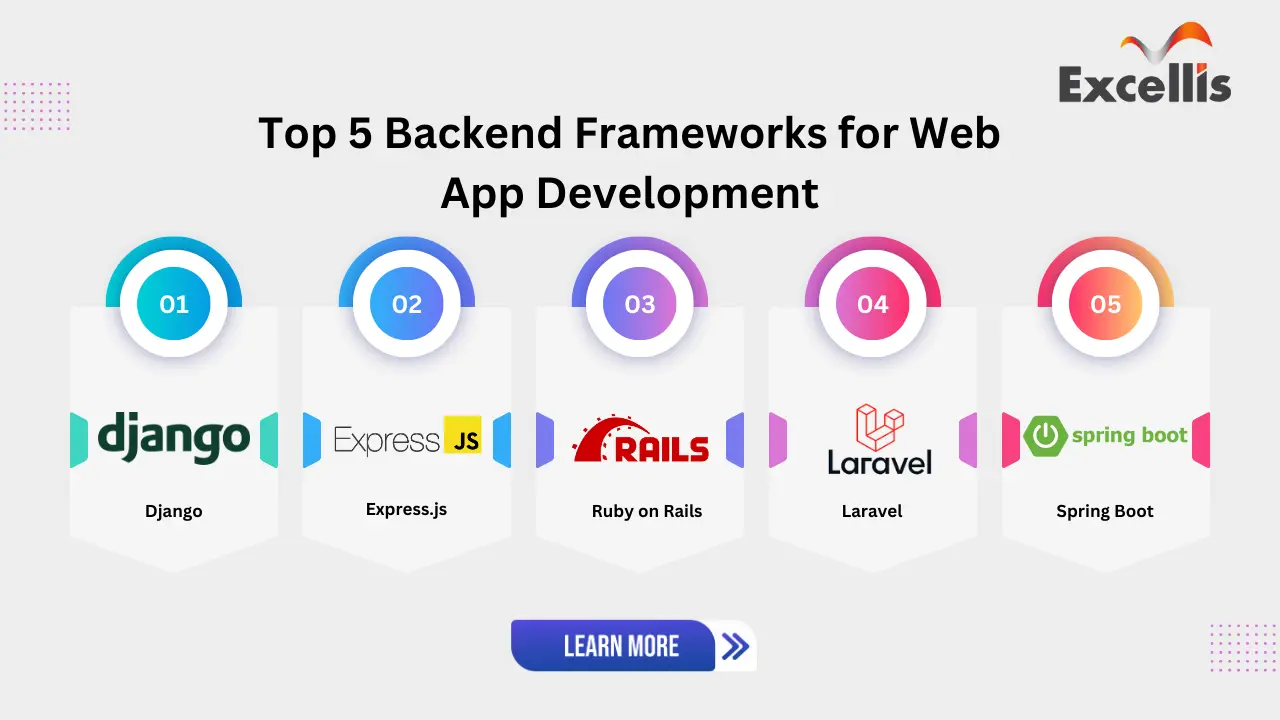
Top 5 Backend Frameworks for Web App Development in 2023

In the dynamic realm of web app development, backend frameworks shape application functionality and efficiency, providing a structured foundation for developers to create robust, scalable systems. Their significance spans from data storage to server-side logic, impacting performance, security, and user experience. This introduction illuminates their crucial role in modern web development.As technology progresses, web app development evolves intricately. We’ve moved from static HTML pages to intricate, dynamic applications requiring sophisticated backend solutions. This section delves into this evolution, highlighting key milestones. Understanding this journey is vital for appreciating the necessity of cutting-edge backend frameworks in today’s digital landscape, guiding us through transformative phases shaping modern web development.

Criteria for Evaluating Backend Frameworks

  • Performance benchmarks:

When assessing backend frameworks, performance benchmarks stand as a cornerstone. Evaluating the execution speed, resource utilization, and responsiveness of a framework under varying conditions provides invaluable insights. Robust benchmarks ensure that the chosen backend framework aligns with the application’s performance requirements, optimizing user experiences and responsiveness.

  • Community support and documentation:

The strength of a backend framework is often reflected in its community support and documentation. A vibrant and engaged community fosters continuous improvement, ensuring quick issue resolution and ongoing updates. Extensive, well-maintained documentation is equally vital, serving as a guide for developers. This section explores how community dynamics and documentation quality contribute to the overall usability and reliability of a backend framework.

  • Scalability and flexibility:

Scalability and flexibility are paramount considerations in the evaluation process. An adept backend framework should seamlessly adapt to the evolving needs of an application, accommodating growth without sacrificing performance. This segment delves into the scalability mechanisms offered by backend frameworks, examining how they handle increasing workloads and maintain flexibility in adapting to diverse development scenarios. Understanding these criteria aids developers in selecting frameworks that align with the dynamic demands of modern web applications.

Find the best web development company in Kolkata for a robust website for your business needs. 

5 Industry Best Backend Frameworks for Web App Development in 2023

Framework 1: Django

Django, a high-level Python web framework, facilitates rapid development with a clean and pragmatic design. It follows the model-view-template (MVT) architectural pattern, emphasizing DRY (Don’t Repeat Yourself) and convention over configuration. Django’s batteries-included philosophy integrates essential components to simplify complex tasks, making it a robust choice for web development.

Key Features:

Django boasts an ORM for database management, a powerful templating engine, and built-in admin panels. Its security features, including protection against common vulnerabilities, contribute to its appeal. Django Rest Framework extends its capabilities for building RESTful APIs, enhancing versatility.

Use Cases:

Django finds applications in diverse domains, from content management systems (e.g., Django CMS) to e-commerce platforms (e.g., Saleor). Its versatility accommodates projects of varying scales, making it suitable for startups and large enterprises alike.

Pros:

  • Rapid development with reusable components.
  • Strong emphasis on security.
  • Extensive documentation and an active community.

Cons:

  • Learning curve for beginners.
  • Convention-heavy, limiting flexibility in certain scenarios.

Framework 2: Express.js

Express.js, built on Node.js, is a minimalist web application framework designed for creating robust APIs and web applications. Leveraging JavaScript on both the server and client sides, it excels in handling asynchronous operations.

Core Features of Express.js:

Express.js simplifies server-side operations with a minimalist, flexible structure. Middleware support enhances functionality, allowing developers to craft modular, extensible applications. It is renowned for its performance and scalability, making it a favorite for building real-time applications.

Real-world Applications:

Express.js is prevalent in building dynamic single-page applications (SPAs) and RESTful APIs. Its simplicity attracts developers working on microservices architecture, enabling efficient creation of scalable and modular systems.

Comparisons with Other Frameworks:

Express.js is often compared with Flask in the Python ecosystem and Sinatra in the Ruby world. Its lightweight nature and emphasis on flexibility distinguish it, especially when compared to more comprehensive frameworks like Django.

Framework 3: Ruby on Rails

Ruby on Rails (Rails) is a full-stack web application framework optimized for programmer happiness. Its convention over configuration approach streamlines development, allowing developers to focus on writing code rather than tedious configuration.

Notable Features:

Rails integrates an ORM, ActiveRecord, simplifying database interactions. Conventionally, it emphasizes the use of RESTful routes and convention-driven development. Additionally, it includes automated testing tools, enhancing the development workflow.

Success Stories:

Ruby on Rails has powered successful applications such as Basecamp, GitHub, and Shopify. Its elegant syntax and developer-friendly environment have contributed to its popularity in startup ecosystems.

Limitations:

  • Learning curve for beginners.
  • Can be perceived as monolithic for smaller projects.

Considerations:

  • Continuous updates maintain relevance.
  • Robust community support.

Framework 4: Laravel

Laravel, a PHP web application framework, prioritizes elegance and simplicity. It employs the Model-View-Controller (MVC) architecture and offers features like routing, Eloquent ORM, and Blade templating, streamlining development.

Eloquent ORM and Blade Templating:

Laravel’s Eloquent ORM simplifies database operations, while Blade templating provides a concise syntax for views. These features contribute to the framework’s appeal for developers seeking an expressive and efficient PHP solution.

Applications in Modern Web Development:

Laravel excels in building RESTful APIs and scalable web applications. It’s the framework of choice for projects requiring a balance between performance and developer-friendly syntax, and it has gained popularity in the Laravel Spark ecosystem for subscription-based services.

Community and Updates:

Laravel boasts a robust community and frequent updates, ensuring the framework remains modern and secure. The Laravel ecosystem includes Laravel Nova for administration panels and Laravel Mix for asset compilation, enhancing its versatility.

Framework 5: Spring Boot

Spring Boot, a part of the larger Spring framework, simplifies the development of Java-based enterprise applications. It embraces convention over configuration, reducing boilerplate code and accelerating development.

Integration with Java:

Spring Boot seamlessly integrates with Java, leveraging the extensive Java ecosystem. It facilitates the creation of standalone, production-grade Spring-based applications with minimal effort.

Microservices Architecture:

Spring Boot is a prominent choice for microservices architecture, offering built-in support for creating independent, deployable services. Its modular design and embedded servers enhance scalability and ease of deployment.

Industry Adoption and Support:

Widely adopted in enterprise environments, Spring Boot benefits from strong industry support. Its compatibility with various databases, messaging systems, and cloud platforms makes it an ideal choice for diverse enterprise applications.

Comparative Analysis


Framework Performance Benchmarking Community Preferences and Trends Scalability and Adaptability
Django Demonstrates robust performance with efficient database handling Active Python community support, trending in large-scale applications Scalable for various project sizes, adaptable to diverse needs
Express.js Recognized for high performance, particularly in handling I/O Strong Node.js community, trending for real-time applications Highly scalable, particularly suited for microservices architecture
Ruby on Rails Efficient performance, particularly for convention-driven apps Strong Ruby community, popular in startup ecosystems Scalable for medium to large projects, adaptable to business growth
Laravel Offers excellent performance and scalability for PHP projects Active PHP community, trending for modern PHP development Highly scalable, adaptable to various project sizes
Spring Boot Demonstrates robust performance and is widely used in enterprises Large Java community, preferred for enterprise-level applications Designed for scalability, particularly suitable for microservices

Emerging Trends in Backend Development

Serverless Architecture:

Serverless architecture, an evolving paradigm, shifts the focus from traditional server management to a cloud-based, event-driven model. Developers can run functions without managing servers directly, reducing operational overhead. This trend streamlines development, enhances scalability, and optimizes cost efficiency by charging only for actual resource consumption.

GraphQL Integration:

GraphQL, an alternative to REST APIs, empowers clients to request precisely the data they need. Its flexibility in data retrieval reduces over-fetching, improving efficiency. As an emerging trend, GraphQL integration provides developers with a more efficient and customizable approach to data communication in web applications.

Containerization and Orchestration:

Containerization (e.g., Docker) and orchestration (e.g., Kubernetes) have become integral to modern backend development. Containers encapsulate applications, ensuring consistency across various environments. Orchestration tools simplify deployment, scaling, and management of containerized applications. This trend enhances portability, scalability, and the overall efficiency of backend systems.

Best Practices in Choosing a Backend Framework

Aligning with Project Requirements:

Selecting a backend framework should align with the specific requirements of the project. Consider factors such as scalability, performance, and ecosystem compatibility. Django, for instance, suits projects with intricate database needs, while Express.js excels in real-time applications. A tailored approach ensures the chosen framework complements the project’s goals.

Considering Developer Expertise:

Evaluate the team’s expertise before selecting a framework. Familiarity with a particular language or ecosystem can expedite development and minimize the learning curve. Assess the framework’s documentation and community support to gauge the available resources for overcoming challenges. A well-matched framework and skilled team contribute to efficient development cycles.

Future-Proofing Considerations:

Future-proofing involves selecting a framework that can evolve with technology trends. Assess the framework’s commitment to updates, community support, and adaptability to emerging technologies. Choosing a framework with a forward-looking mindset ensures that the application remains relevant and maintainable as the technology landscape evolves.

Challenges and Solutions in Backend Development

Common Challenges Faced by Developers:

Backend development presents challenges such as scalability bottlenecks, security vulnerabilities, and performance optimization hurdles. Integrating third-party services, handling large datasets, and maintaining consistency across distributed systems are additional complexities developers encounter.

Solutions and Workarounds:

Scalability challenges can be addressed through efficient load balancing and caching mechanisms. Security vulnerabilities require continuous monitoring, regular updates, and adherence to best practices. Performance optimization often involves database indexing, asynchronous processing, and code profiling. Integrating third-party services necessitates robust error handling and adherence to service-level agreements.

Learning from Others’ Mistakes:

Understanding common pitfalls and learning from others’ experiences is crucial in backend development. Engaging in community forums, participating in knowledge-sharing sessions, and staying updated on case studies contribute to a collective learning experience. Learning from mistakes helps developers anticipate challenges and proactively implement solutions.

Framework Updates and Roadmaps

Recent Updates from Each Framework:

Django: 

Recent updates focus on enhancing performance, security, and asynchronous support. Features like Django Channels enable real-time capabilities, aligning with modern web application demands.

Express.js: 

Ongoing updates refine performance and security aspects. The framework evolves with Node.js advancements, ensuring compatibility and optimization for real-time applications.

Ruby on Rails: 

Continuous updates introduce improvements in speed, security, and developer experience. Features like Action Mailbox and Action Text enhance Rails’ capabilities.

Laravel:

Laravel’s recent updates prioritize developer convenience and application scalability. Improvements in the Laravel ecosystem, including Laravel Mix and Nova, contribute to a more streamlined development experience.

Spring Boot: 

Recent updates focus on enhancing support for microservices architecture, optimizing performance, and maintaining compatibility with the latest Java releases.

Future Roadmaps and Anticipated Features:

Django: 

Future roadmaps suggest a continued focus on performance optimization, support for newer Python versions, and enhancements in developer tools for a more seamless experience.

Express.js: 

The roadmap includes further integration with modern JavaScript features and continuous improvements in scalability and real-time capabilities.

Ruby on Rails: 

Upcoming features aim to boost developer productivity, improve scalability, and introduce tools that align with evolving web development standards.

Laravel: 

Future plans include advancements in GraphQL support, improvements in API development, and enhancements in the Laravel ecosystem to maintain its status as a versatile PHP framework.

Spring Boot: 

The roadmap emphasizes ongoing support for microservices architecture, compatibility with the evolving Java ecosystem, and enhancements in deployment and monitoring tools.

Conclusion

The ever-evolving world of backend development demands a nuanced understanding of frameworks, emerging trends, and best practices. A leading web development company in Kolkata offers a website that matches all your business requirements. From the robust versatility of Django to the real-time efficiency of Express.js, developers face a diverse array of choices. As serverless architecture, GraphQL integration, and containerization reshape the landscape, staying informed is paramount. Best practices, aligning with project needs and considering future-proofing, guide intelligent framework selection. Acknowledging challenges and learning from collective experiences fosters growth.


Optimizing React for Search Engines: Strategies for SEO-Friendly Web Apps

SEO is the foundation of online visibility, boosting a website’s ranking and driving organic traffic. It’s vital for effective audience reach. Incorporating SEO into web development ensures content is easily discoverable. However, React, a dynamic interface builder, poses unique SEO challenges. Traditional search crawlers may struggle with React’s dynamic content. Overcoming this requires clever techniques like server-side rendering, ensuring React apps or websites rank well and are search-friendly. A professional web development company in Kolkata offers React websites that are SEO-friendly.
This blog will discuss the strategies to create an SEO-friendly web app with React. So, let’s begin!

Understanding SEO Basics

Search Engine Crawling and Indexing

Search engines like Google use crawlers to navigate the web, scanning websites for content. Once crawled, the information is indexed, cataloging it for future retrieval in search results. Ensuring a website is easily accessible and comprehensible to these crawlers is essential for effective SEO.

Keyword Research and Optimization

Keyword research involves identifying users’ words and phrases when searching for specific content. Integrating relevant keywords into website content, meta descriptions, and headers enhances visibility in search results, aligning the site with user intent.

On-Page SEO Best Practices

On-page SEO focuses on optimizing individual web pages to rank higher and earn more organic traffic. This includes optimizing title tags, meta descriptions, heading tags, URL structure, and content quality. Complying with on-page SEO best practices ensures a website is well-positioned for search engine success.

Incorporating SEO in React

Rendering Techniques and SEO Implications

In React, the choice of rendering technique impacts SEO. Traditional client-side rendering (CSR) often poses challenges for search engine crawlers due to its reliance on JavaScript to assemble content. Understanding these implications is crucial for effective SEO integration.

Server-Side Rendering (SSR) vs Client-Side Rendering (CSR)

The SEO community debates the merits of Server-Side Rendering (SSR) versus Client-Side Rendering (CSR) in React. SSR generates HTML on the server, offering search engines pre-rendered content. CSR assembles content dynamically on the client side, potentially causing SEO challenges. Evaluating the trade-offs and selecting the right approach is a critical decision in React development.

Find a leading Reactjs development company to build an SEO-friendly website.

Hybrid Rendering Approaches

Hybrid rendering combines the best of SSR and CSR. It allows for server-side rendering of critical content while utilizing CSR for dynamic elements. This approach strikes a balance between SEO-friendly pre-rendered content and interactive client-side functionality.

Structuring Content for SEO

Semantic HTML Elements in React

Using semantic HTML elements in React helps search engines understand the content’s structure and context. Properly structured HTML enhances the user experience and improves SEO rankings.

Proper Usage of Headings and Subheadings

Headings (H1, H2, H3, etc.) provide a hierarchy to content, making it more digestible for users and search engines. Using headings correctly is a fundamental aspect of on-page SEO.

Creating SEO-Friendly URLs

Optimizing URLs with descriptive and keyword-rich slugs not only aids user navigation but also enhances SEO. Clean and concise URLs contribute to better search engine rankings.

Optimizing Images and Media

Alt Texts for Images and Accessibility

Adding descriptive alt texts to images improves accessibility for visually impaired users and provides search engines with valuable context about the image content. This accessibility feature indirectly benefits SEO.

Lazy Loading for Improved Performance and SEO

Lazy-loading images can enhance website performance by reducing page load times. Improved performance positively impacts user experience and SEO ranking.

Sitemaps for Media Files

Incorporating media files into a sitemap helps search engines discover and index these assets, ensuring they contribute to SEO efforts. A professional web development company in Kolkata helps incorporate such a strategy for an SEO-friendly React web app.

Enhancing User Experience and SEO

Page Load Speed and SEO Ranking

Fast-loading pages are favoured by users and search engines alike. Google, for instance, considers page speed in its ranking algorithm. Optimizing site performance is crucial for SEO success.

Mobile Optimization and SEO

As mobile device usage continues to surge, mobile optimization is essential. A mobile-friendly design enhances user experience and positively influences search engine rankings.

User Engagement Metrics and SEO

User engagement metrics like bounce rate, time on page, and click-through rate are used by search engines to assess content quality. Higher engagement correlates with improved SEO rankings.

Navigational Best Practices

Creating Intuitive Navigation Menus

Intuitive navigation menus help users find content easily, leading to better user experience and SEO rankings. Well-structured menus enhance crawlability.

Implementing Breadcrumbs for Improved UX and SEO

Breadcrumbs provide users with a clear path back to the homepage or parent pages. They improve navigation and contribute to better SEO rankings.

Technical SEO Considerations

Proper Use of Meta Tags in React

Meta tags, including title tags and meta descriptions, play a crucial role in SEO. Properly crafted meta tags provide concise information about a page’s content, influencing click-through rates and search rankings.

Handling Redirects and Canonical URLs

Properly managing redirects and canonical URLs ensures that search engines index the right content. Avoiding duplicate content issues is vital for SEO. A professional web development company in Kolkata helps incorporate such a strategy for an SEO-friendly React web app.

Robots.txt and Noindex Tags

Robots.txt and no-index tags allow webmasters to control which parts of the website are indexed by search engines. They are valuable tools for managing SEO.

Handling Dynamic Content

SEO-friendly AJAX and React

Ensuring AJAX requests and dynamic content are SEO-friendly involves using techniques like server-side rendering or providing pre-rendered content to search engines.

Hashbang URLs vs HTML5 PushState

Choosing between hashbang URLs (#!) and HTML5 pushState for routing in single-page applications impacts URL structure and SEO. Evaluating the trade-offs is important when designing SEO-friendly SPAs.

SEO for Single Page Applications (SPAs)

Challenges and Solutions for SEO in SPAs

SPAs can pose SEO challenges due to their reliance on client-side rendering. Strategies like pre-rendering and server-side rendering are critical for overcoming these challenges.

Implementing Server-Side Rendering (SSR) in SPAs

Implementing SSR in SPAs enables search engines to receive pre-rendered HTML, improving SEO visibility and ensuring content is indexed effectively.

Accessibility and SEO

Importance of Accessibility in SEO Rankings

Accessibility is not only a legal and ethical requirement but also influences SEO rankings. Websites that provide equal access to all users receive preferential treatment from search engines.

React ARIA and Accessibility Best Practices

React ARIA (Accessible Rich Internet Applications) is a set of attributes that enhances accessibility. Implementing these attributes and following accessibility best practices contributes to better SEO rankings.

Schema Markup and Rich Snippets

Implementing Schema.org Markup in React

Schema markup provides structured data to search engines, enriching search results with additional information. Implementing schema markup in React can lead to more appealing and informative search listings.

Enhancing Search Results with Rich Snippets

Rich snippets are visually enhanced search results that attract user attention. Implementing schema markup can enable rich snippets, improving click-through rates and SEO visibility. A professional web development company in Kolkata helps incorporate such a strategy for an SEO-friendly React web app.

Tracking and Analyzing SEO Performance

Setting up Google Analytics for React Apps

Tracking and analyzing SEO performance is essential for optimizing strategies. Setting up Google Analytics for React apps provides insights into user behaviour and site performance.

Monitoring Rankings and Organic Traffic

Continuous monitoring of search rankings and organic traffic helps webmasters adapt SEO strategies. Regular assessments ensure a website remains competitive in search results.

Content Quality and Relevance

Creating High-Quality, Relevant Content

Compelling content is the linchpin of successful SEO. Crafting informative, engaging material that addresses user queries and provides value is paramount. Quality content attracts organic traffic and encourages user interaction, positively impacting search rankings.

Avoiding Duplicate Content Issues

Duplicate content can hinder SEO efforts. Ensuring each page offers unique, valuable information is crucial. Implementing canonical tags and avoiding content duplication across different URLs helps search engines understand which version to index.

Social Signals and SEO

Leveraging Social Media for SEO

Social signals, such as shares, likes, and comments on social media platforms, can indirectly impact SEO. Engaging content that resonates with users often leads to increased social activity, potentially influencing search engine rankings.

Incorporating Open Graph Tags

Open Graph tags enable websites to control how their content appears when shared on social media platforms. Proper implementation enhances the visual appeal of shared links, potentially driving more traffic and improving SEO.

Link Building and Backlinks

Quality Backlinks and SEO

High-quality backlinks from authoritative websites signal to search engines that a site offers valuable content. Earning organic, relevant backlinks is a critical aspect of off-page SEO that positively impacts rankings.

Natural Link Acquisition Strategies

Natural link acquisition involves creating valuable content that naturally attracts backlinks. Providing unique insights, conducting original research, and offering exceptional resources are effective strategies for earning quality links.

Local SEO Strategies

Importance of Local SEO

For businesses with a local presence, optimizing for local search is crucial. Local SEO ensures that businesses appear in relevant local search results, helping attract nearby customers.

Google My Business Optimization

Optimizing a Google My Business profile enhances local visibility. Providing accurate business information, images, and customer reviews on the profile contributes to better local search rankings. A professional digital marketing company in Kolkata helps incorporate such a strategy for an SEO-friendly React web app.

Keeping Abreast of Algorithm Changes

Staying Updated with SEO Trends

Search engine algorithms evolve over time, affecting search rankings. Staying informed about SEO trends, algorithm updates, and best practices ensures that optimization efforts remain effective.

Adapting Strategies to Algorithm Changes

When search algorithms undergo significant updates, adapting SEO strategies becomes essential. Analyzing the impact of algorithm changes and adjusting optimization techniques ensures continued success in search rankings.

User Feedback and User Experience

Incorporating User Feedback

Listening to user feedback provides valuable insights into improving website content and functionality. Addressing user concerns and preferences can lead to a more satisfying experience, ultimately benefiting SEO.

User Experience as a Ranking Factor

Search engines prioritize user experience when determining search rankings. Factors such as page load speed, mobile-friendliness, and intuitive navigation significantly influence SEO success.

Conclusion

In the dynamic world of web development, optimizing React applications for search engines is paramount. A professional IT company in Kolkata helps incorporate strategies to optimize React web apps for SEO. By implementing a holistic SEO strategy, including server-side rendering, structured content, and user-centric design, webmasters can enhance visibility and user experience. Attention to technical details, such as proper meta tags and canonical URLs, ensures effective indexing. Prioritizing accessibility and ethical SEO practices further solidifies a web app’s online presence. By amalgamating these strategies, React applications can not only excel in user satisfaction but also thrive in search engine rankings, ultimately achieving a well-rounded, SEO-friendly digital footprint.

14 Benefits of Using Laravel Framework for Web Development

In the dynamic realm of web development, choosing the right framework can be a game-changer. Among the myriad options, Laravel emerges as a standout choice. Renowned for its elegant syntax and developer-friendly features, Laravel has revolutionized PHP web application development. This robust framework offers a structured foundation, streamlining tasks and empowering developers to create secure, scalable, and high-performing web applications. From seamless authorization to efficient caching and extensive third-party integrations, Laravel brings a myriad of advantages to the table. In this blog, we’ll delve into the 14 compelling benefits that make Laravel the preferred framework for modern web development.

☑ What is Laravel Framewrok?

Laravel is a renowned PHP framework of web applications, known for its elegant syntax and developer-friendly features. It provides a structured foundation for building robust and scalable web applications. With a focus on simplicity and flexibility, Laravel streamlines tasks like routing, authentication, caching, and database management. Its MVC architecture separates application logic, enhancing code maintainability. Laravel also offers features like powerful ORM (Eloquent), robust testing capabilities, and a vibrant ecosystem of extensions. This makes it a top choice for developers seeking efficiency and productivity in web development projects.

Why Choose Laravel for Web Development?

Choosing Laravel over other frameworks offers several compelling advantages. Firstly, its robust authorization system simplifies user access control, vital for secure applications. Laravel also excels in seamless email services, supporting multiple drivers for efficient communication. Its elegant syntax and caching mechanisms contribute to faster development, enhancing user experience. Security is paramount, with protection against common vulnerabilities. Effective error handling streamlines issue resolution, ensuring application reliability. The built-in testing suite assures code integrity, while clean URL routing aids SEO efforts. With MVC architecture, Laravel promotes structured development, facilitating scalability. Integration of message queues and task scheduling automates processes, boosting efficiency. These features collectively establish Laravel as a top choice for web development.

Hire a Laravel developer from the best web development company in Kolkata.

14 Benefits of Laravel Framework

Being one of the best web development frameworks, Laravel poses significant benefits to web development.  Check them out below:

      📌 MVC Architecture for Structure

Following the Model-View-Controller (MVC) architectural pattern, Laravel enforces a structured and organized development approach. This separation of concerns facilitates code maintainability, scalability, and testability. It also enables multiple developers to collaboratively work on different aspects of the application, streamlining the development process.  

     📌 Robust Authorization System

Laravel’s authorization system is a cornerstone of its security features, offering a powerful and flexible way to manage user access. Through its elegant syntax and middleware, developers can effortlessly define roles and permissions. This ensures that only authenticated and authorized users can access specific parts of the application, fortifying data security and safeguarding user privacy. This feature is instrumental in creating applications with varying user roles, such as admin panels and user-specific dashboards.

     📌 Enhanced Speed and Efficiency

The efficiency of Laravel is evident in its elegant syntax and well-structured codebase. This foundation accelerates the development process, translating to quicker project completion. Further enhancing speed, Laravel incorporates built-in caching mechanisms. Additionally, the framework supports database indexing and optimization techniques, which contribute significantly to application speed and responsiveness. These features collectively guarantee a smooth and efficient user experience.

     📌 Top-Notch Security Measures

Laravel places a paramount emphasis on application security. It shields against prevalent vulnerabilities like SQL injection, cross-site scripting, and cross-site request forgery. Laravel achieves this through a combination of features, including robust password hashing, encryption, and secure session management. These measures collectively fortify the application, ensuring it stands up to the highest standards of security.

     📌 Effective Error and Exception Handling

Exceptional error handling is a critical aspect of Laravel’s appeal. The framework simplifies the process with a unified and intuitive approach. Developers benefit from detailed error pages, comprehensive logging, and customizable error messages. These resources significantly expedite the identification and resolution of issues, bolstering the reliability and stability of the application.   

    📌 Seamless Mail Services

Laravel goes above and beyond in simplifying email services making backend web development convenient. It supports a range of drivers, including SMTP, Mailgun, and Sendmail, providing developers with versatile options for email delivery. The framework furnishes a clean and expressive API for sending not just emails, but also notifications. This capability streamlines user engagement and communication, enhancing the overall user experience. Additionally, Laravel’s seamless integration allows for easy customization and the incorporation of various delivery channels, ensuring that communication is personalized and effective.

    📌 Built-in Testing Suite

Laravel’s built-in testing suite is a boon for developers aiming to maintain code integrity. It offers a comprehensive set of tools and utilities for crafting unit tests, feature tests, and even browser tests. This functionality is essential in ensuring that code alterations do not inadvertently introduce regressions or unintended side effects. By streamlining the testing process, Laravel empowers developers to deliver robust and dependable applications.

    📌 Caching for Better Performance

Laravel’s built-in caching mechanisms play a pivotal role in optimizing performance. By storing frequently accessed data in cache, the application can retrieve it swiftly, reducing database queries and response times. This leads to a significantly enhanced user experience, particularly in high-traffic scenarios. Laravel supports various caching drivers like Redis and Memcached, providing developers with flexibility in implementation. Leveraging caching effectively not only improves the responsiveness of the application but also conserves server resources, making it a crucial tool for achieving optimal performance in web development.

    📌 Clean and SEO-Friendly URL Routing

Laravel’s routing system excels in creating clean, human-readable, and SEO-friendly URLs. Its configuration is straightforward, simplifying the management of even the most complex routing requirements. Named routes further enhance this feature, allowing for streamlined URL generation and redirection within the application. This ensures that users can navigate the application intuitively, while also benefiting SEO efforts.

SEO and Laravel (1)

    📌 Message Queue System Integration

Laravel’s built-in support for message queues is a game-changer for handling time-consuming tasks. By offloading these tasks to a queue, the main application can continue running smoothly, enhancing the overall user experience. Laravel supports various queue drivers, including Redis and RabbitMQ, providing developers with flexibility and a clean API for efficient queue management.

    📌 Task Scheduling for Automation

Automating tasks is a breeze with Laravel’s task-scheduling feature. Developers can effortlessly set up automated processes such as email sending, database maintenance, and routine tasks. This ensures that critical tasks are executed at the right times, reducing the need for manual intervention. This not only improves application efficiency but also frees up valuable developer time for more strategic tasks.

    📌 Easy Third-Party Integrations

Laravel’s modular architecture and extensive composer packages make integrating third-party services a breeze. Whether it’s payment gateways, APIs, or external libraries, Laravel’s robust ecosystem simplifies the process. This enables developers to enhance functionality without reinventing the wheel, saving time and effort in development.

    📌 Simple Website Maintenance

Laravel’s elegant syntax and organized codebase facilitate straightforward website maintenance. Its clear documentation and intuitive structure make it easy for developers to navigate and update existing code. This simplicity ensures that ongoing maintenance tasks, such as adding features or fixing bugs, can be accomplished efficiently, reducing downtime and enhancing the user experience.

Web maintanance

    📌 Cost-Efficient Site Development

Laravel accelerates development without compromising quality, making it a cost-effective choice. Its built-in features, such as authentication and caching, significantly reduce development time. Additionally, Laravel’s robust community and extensive documentation provide ample resources, lowering the learning curve for developers. This combination of efficiency and accessibility translates to cost savings in the development process.

User Read Also: How Does A Web Development Company Ensure Your Site’s Smooth Operation?

How Fast are Laravel-based Web Applications? 

Laravel-based web applications are known for their exceptional speed and efficiency. Thanks to its elegant syntax, well-structured codebase, and built-in caching mechanisms, Laravel significantly accelerates development. Additionally, support for database indexing and optimization techniques further boosts application speed and responsiveness, making it best backend framework. These features collectively ensure a seamless and rapid user experience, making Laravel a top choice for developers aiming to deliver high-performance web applications.

☑  Conclusion 

In the ever-evolving landscape of web development, the choice of framework wields significant influence. Laravel, with its elegant syntax, robust security measures, and a plethora of features, stands as a testament to the evolution of PHP development. Its seamless authorization, efficient caching, and extensive third-party integrations exemplify its prowess. Whether it’s for rapid development, cost efficiency, or maintaining clean, organized code, Laravel emerges as a frontrunner. The blend of simplicity and sophistication makes Laravel a cornerstone in modern web development. Choosing Laravel isn’t just a choice; it’s a strategic decision towards crafting web applications that excel in performance, security, and user experience.

More reasons to trust us!

Excellis IT is building a skilled team in IT support, customer support, digital marketing, and back-office services for modern companies.

Excellis it is an esteemed ISO/IEC 27001:2022 certified company

We achieved the prestigious certification by MSME in 2019

We are certified by the Central Vigilance Commission

We are an honoured members of NASSCOM since 2022

Excellis it is an esteemed ISO/IEC 9001:2008 certified company

Excellis it is an esteemed ISO/IEC 20000-1:2018 certified company

We are certified by the CMMI MATURITY LEVEL 5

We are certified by the GeM

Visit our Clutch profile

and discover what our clients think about working with us.

ONLINE REVIEWS: