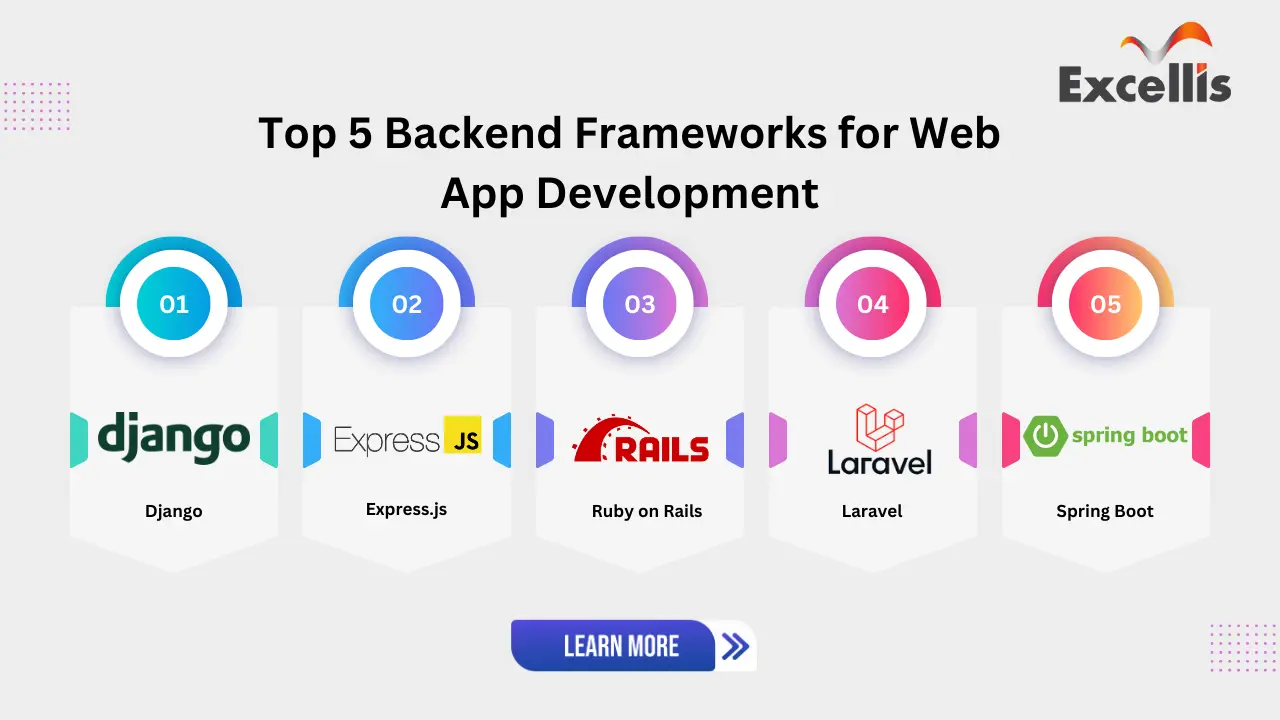
Top 5 Backend Frameworks for Web App Development in 2023

In the dynamic realm of web app development, backend frameworks shape application functionality and efficiency, providing a structured foundation for developers to create robust, scalable systems. Their significance spans from data storage to server-side logic, impacting performance, security, and user experience. This introduction illuminates their crucial role in modern web development.As technology progresses, web app development evolves intricately. We’ve moved from static HTML pages to intricate, dynamic applications requiring sophisticated backend solutions. This section delves into this evolution, highlighting key milestones. Understanding this journey is vital for appreciating the necessity of cutting-edge backend frameworks in today’s digital landscape, guiding us through transformative phases shaping modern web development.

Criteria for Evaluating Backend Frameworks

  • Performance benchmarks:

When assessing backend frameworks, performance benchmarks stand as a cornerstone. Evaluating the execution speed, resource utilization, and responsiveness of a framework under varying conditions provides invaluable insights. Robust benchmarks ensure that the chosen backend framework aligns with the application’s performance requirements, optimizing user experiences and responsiveness.

  • Community support and documentation:

The strength of a backend framework is often reflected in its community support and documentation. A vibrant and engaged community fosters continuous improvement, ensuring quick issue resolution and ongoing updates. Extensive, well-maintained documentation is equally vital, serving as a guide for developers. This section explores how community dynamics and documentation quality contribute to the overall usability and reliability of a backend framework.

  • Scalability and flexibility:

Scalability and flexibility are paramount considerations in the evaluation process. An adept backend framework should seamlessly adapt to the evolving needs of an application, accommodating growth without sacrificing performance. This segment delves into the scalability mechanisms offered by backend frameworks, examining how they handle increasing workloads and maintain flexibility in adapting to diverse development scenarios. Understanding these criteria aids developers in selecting frameworks that align with the dynamic demands of modern web applications.

Find the best web development company in Kolkata for a robust website for your business needs. 

5 Industry Best Backend Frameworks for Web App Development in 2023

Framework 1: Django

Django, a high-level Python web framework, facilitates rapid development with a clean and pragmatic design. It follows the model-view-template (MVT) architectural pattern, emphasizing DRY (Don’t Repeat Yourself) and convention over configuration. Django’s batteries-included philosophy integrates essential components to simplify complex tasks, making it a robust choice for web development.

Key Features:

Django boasts an ORM for database management, a powerful templating engine, and built-in admin panels. Its security features, including protection against common vulnerabilities, contribute to its appeal. Django Rest Framework extends its capabilities for building RESTful APIs, enhancing versatility.

Use Cases:

Django finds applications in diverse domains, from content management systems (e.g., Django CMS) to e-commerce platforms (e.g., Saleor). Its versatility accommodates projects of varying scales, making it suitable for startups and large enterprises alike.

Pros:

  • Rapid development with reusable components.
  • Strong emphasis on security.
  • Extensive documentation and an active community.

Cons:

  • Learning curve for beginners.
  • Convention-heavy, limiting flexibility in certain scenarios.

Framework 2: Express.js

Express.js, built on Node.js, is a minimalist web application framework designed for creating robust APIs and web applications. Leveraging JavaScript on both the server and client sides, it excels in handling asynchronous operations.

Core Features of Express.js:

Express.js simplifies server-side operations with a minimalist, flexible structure. Middleware support enhances functionality, allowing developers to craft modular, extensible applications. It is renowned for its performance and scalability, making it a favorite for building real-time applications.

Real-world Applications:

Express.js is prevalent in building dynamic single-page applications (SPAs) and RESTful APIs. Its simplicity attracts developers working on microservices architecture, enabling efficient creation of scalable and modular systems.

Comparisons with Other Frameworks:

Express.js is often compared with Flask in the Python ecosystem and Sinatra in the Ruby world. Its lightweight nature and emphasis on flexibility distinguish it, especially when compared to more comprehensive frameworks like Django.

Framework 3: Ruby on Rails

Ruby on Rails (Rails) is a full-stack web application framework optimized for programmer happiness. Its convention over configuration approach streamlines development, allowing developers to focus on writing code rather than tedious configuration.

Notable Features:

Rails integrates an ORM, ActiveRecord, simplifying database interactions. Conventionally, it emphasizes the use of RESTful routes and convention-driven development. Additionally, it includes automated testing tools, enhancing the development workflow.

Success Stories:

Ruby on Rails has powered successful applications such as Basecamp, GitHub, and Shopify. Its elegant syntax and developer-friendly environment have contributed to its popularity in startup ecosystems.

Limitations:

  • Learning curve for beginners.
  • Can be perceived as monolithic for smaller projects.

Considerations:

  • Continuous updates maintain relevance.
  • Robust community support.

Framework 4: Laravel

Laravel, a PHP web application framework, prioritizes elegance and simplicity. It employs the Model-View-Controller (MVC) architecture and offers features like routing, Eloquent ORM, and Blade templating, streamlining development.

Eloquent ORM and Blade Templating:

Laravel’s Eloquent ORM simplifies database operations, while Blade templating provides a concise syntax for views. These features contribute to the framework’s appeal for developers seeking an expressive and efficient PHP solution.

Applications in Modern Web Development:

Laravel excels in building RESTful APIs and scalable web applications. It’s the framework of choice for projects requiring a balance between performance and developer-friendly syntax, and it has gained popularity in the Laravel Spark ecosystem for subscription-based services.

Community and Updates:

Laravel boasts a robust community and frequent updates, ensuring the framework remains modern and secure. The Laravel ecosystem includes Laravel Nova for administration panels and Laravel Mix for asset compilation, enhancing its versatility.

Framework 5: Spring Boot

Spring Boot, a part of the larger Spring framework, simplifies the development of Java-based enterprise applications. It embraces convention over configuration, reducing boilerplate code and accelerating development.

Integration with Java:

Spring Boot seamlessly integrates with Java, leveraging the extensive Java ecosystem. It facilitates the creation of standalone, production-grade Spring-based applications with minimal effort.

Microservices Architecture:

Spring Boot is a prominent choice for microservices architecture, offering built-in support for creating independent, deployable services. Its modular design and embedded servers enhance scalability and ease of deployment.

Industry Adoption and Support:

Widely adopted in enterprise environments, Spring Boot benefits from strong industry support. Its compatibility with various databases, messaging systems, and cloud platforms makes it an ideal choice for diverse enterprise applications.

Comparative Analysis


Framework Performance Benchmarking Community Preferences and Trends Scalability and Adaptability
Django Demonstrates robust performance with efficient database handling Active Python community support, trending in large-scale applications Scalable for various project sizes, adaptable to diverse needs
Express.js Recognized for high performance, particularly in handling I/O Strong Node.js community, trending for real-time applications Highly scalable, particularly suited for microservices architecture
Ruby on Rails Efficient performance, particularly for convention-driven apps Strong Ruby community, popular in startup ecosystems Scalable for medium to large projects, adaptable to business growth
Laravel Offers excellent performance and scalability for PHP projects Active PHP community, trending for modern PHP development Highly scalable, adaptable to various project sizes
Spring Boot Demonstrates robust performance and is widely used in enterprises Large Java community, preferred for enterprise-level applications Designed for scalability, particularly suitable for microservices

Emerging Trends in Backend Development

Serverless Architecture:

Serverless architecture, an evolving paradigm, shifts the focus from traditional server management to a cloud-based, event-driven model. Developers can run functions without managing servers directly, reducing operational overhead. This trend streamlines development, enhances scalability, and optimizes cost efficiency by charging only for actual resource consumption.

GraphQL Integration:

GraphQL, an alternative to REST APIs, empowers clients to request precisely the data they need. Its flexibility in data retrieval reduces over-fetching, improving efficiency. As an emerging trend, GraphQL integration provides developers with a more efficient and customizable approach to data communication in web applications.

Containerization and Orchestration:

Containerization (e.g., Docker) and orchestration (e.g., Kubernetes) have become integral to modern backend development. Containers encapsulate applications, ensuring consistency across various environments. Orchestration tools simplify deployment, scaling, and management of containerized applications. This trend enhances portability, scalability, and the overall efficiency of backend systems.

Best Practices in Choosing a Backend Framework

Aligning with Project Requirements:

Selecting a backend framework should align with the specific requirements of the project. Consider factors such as scalability, performance, and ecosystem compatibility. Django, for instance, suits projects with intricate database needs, while Express.js excels in real-time applications. A tailored approach ensures the chosen framework complements the project’s goals.

Considering Developer Expertise:

Evaluate the team’s expertise before selecting a framework. Familiarity with a particular language or ecosystem can expedite development and minimize the learning curve. Assess the framework’s documentation and community support to gauge the available resources for overcoming challenges. A well-matched framework and skilled team contribute to efficient development cycles.

Future-Proofing Considerations:

Future-proofing involves selecting a framework that can evolve with technology trends. Assess the framework’s commitment to updates, community support, and adaptability to emerging technologies. Choosing a framework with a forward-looking mindset ensures that the application remains relevant and maintainable as the technology landscape evolves.

Challenges and Solutions in Backend Development

Common Challenges Faced by Developers:

Backend development presents challenges such as scalability bottlenecks, security vulnerabilities, and performance optimization hurdles. Integrating third-party services, handling large datasets, and maintaining consistency across distributed systems are additional complexities developers encounter.

Solutions and Workarounds:

Scalability challenges can be addressed through efficient load balancing and caching mechanisms. Security vulnerabilities require continuous monitoring, regular updates, and adherence to best practices. Performance optimization often involves database indexing, asynchronous processing, and code profiling. Integrating third-party services necessitates robust error handling and adherence to service-level agreements.

Learning from Others’ Mistakes:

Understanding common pitfalls and learning from others’ experiences is crucial in backend development. Engaging in community forums, participating in knowledge-sharing sessions, and staying updated on case studies contribute to a collective learning experience. Learning from mistakes helps developers anticipate challenges and proactively implement solutions.

Framework Updates and Roadmaps

Recent Updates from Each Framework:

Django: 

Recent updates focus on enhancing performance, security, and asynchronous support. Features like Django Channels enable real-time capabilities, aligning with modern web application demands.

Express.js: 

Ongoing updates refine performance and security aspects. The framework evolves with Node.js advancements, ensuring compatibility and optimization for real-time applications.

Ruby on Rails: 

Continuous updates introduce improvements in speed, security, and developer experience. Features like Action Mailbox and Action Text enhance Rails’ capabilities.

Laravel:

Laravel’s recent updates prioritize developer convenience and application scalability. Improvements in the Laravel ecosystem, including Laravel Mix and Nova, contribute to a more streamlined development experience.

Spring Boot: 

Recent updates focus on enhancing support for microservices architecture, optimizing performance, and maintaining compatibility with the latest Java releases.

Future Roadmaps and Anticipated Features:

Django: 

Future roadmaps suggest a continued focus on performance optimization, support for newer Python versions, and enhancements in developer tools for a more seamless experience.

Express.js: 

The roadmap includes further integration with modern JavaScript features and continuous improvements in scalability and real-time capabilities.

Ruby on Rails: 

Upcoming features aim to boost developer productivity, improve scalability, and introduce tools that align with evolving web development standards.

Laravel: 

Future plans include advancements in GraphQL support, improvements in API development, and enhancements in the Laravel ecosystem to maintain its status as a versatile PHP framework.

Spring Boot: 

The roadmap emphasizes ongoing support for microservices architecture, compatibility with the evolving Java ecosystem, and enhancements in deployment and monitoring tools.

Conclusion

The ever-evolving world of backend development demands a nuanced understanding of frameworks, emerging trends, and best practices. A leading web development company in Kolkata offers a website that matches all your business requirements. From the robust versatility of Django to the real-time efficiency of Express.js, developers face a diverse array of choices. As serverless architecture, GraphQL integration, and containerization reshape the landscape, staying informed is paramount. Best practices, aligning with project needs and considering future-proofing, guide intelligent framework selection. Acknowledging challenges and learning from collective experiences fosters growth.

12 Tips To Secure Your E-Commerce Website

All small to large-scale businesses deploy E-commerce websites to ensure 24/7 access to international buyers and sellers, thus ensuring quick and secure transactions of wealth. For instance, all outstanding website development services and website development companies use this feature, i.e., E-commerce websites, as a medium of commerce. In this digital marketing era, means like E-Commerce which create a connection between the user and the provider, are indispensable. According to a research firm, Statista: roughly 270 million Americans made online purchases in 2019, spending a total sum of 548 billion dollars. Thus services like UI/UX design which aim to build consciousness of the brand by creating a connection between the user and the service providers, have acquired great significance in our times.


However, there is a dark side to it. All these indispensability and usefulness also made E-Commerce websites territories of invisible warfare which is silently raging behind the curtain. Since these websites are treasure troves of financial and personal information, it made them all too privy to attacks from manifold sides, such as hackers, criminals, terrorists, malware, and so forth. It will thus be redundant to argue how security is important for an E-commerce website. Thus, ensuring the safety of E-Commerce websites not only ensures maintaining the data safety of the customers and hence their trust, but also the safety of the company. The best way to outwit the hackers and malevolence thus amounts to stay updated on all the possible ways your E-commerce website can be abused. There are plentiful ways to ensure this. Below are some security measures for E-commerce websites:


PCI DSS (Payment Card Industry Data Security Standard): PCI DSS is an industry protocol that ascertains the credit card information collected online is being stored and deployed securely.


Password Hygiene: The weakest links of an E-commerce website are sometimes the customers. Though there are many security technologies such as facial recognition, fingerprint recognition, two factors authentication, passwords are still the standard security precaution adopted by many customers. It may feel cumbersome to create and manage many complicated passwords with numeric, lower-case, upper-case, and so on. For this reason, some users may reuse a single password for multiple purposes. This practice, in turn, makes the content extremely vulnerable to hackers since if they can take down one password, they may get their hands on all the other contents. Thus to avert such intrusions, careful password hygiene is recommended. In our times, there are many trusted password managers developed by manifold software companies. Using them to keep a tab of passwords is strictly advised in order to avert such security threats.


Using HTTPS (Hyper Text Transfer Protocol Secure): HTTPS is an online protocol for secure interactions over the web since HTTPS websites are certified and hence deemed secure. Buying a Secure Socket Layer certificate enables HTTPS for SMBs. HTTPS authentication is not merely favored by the customers but also by the search engine of Google. Needless to say that HTTPS is considered a mark of authenticity for a secure E-commerce platform.


International Organisation for Standardization (ISO): ISO is a set of international compliance to secure safe internet transactions. The ISO/IEC 27001:2013 standard, one of their protocols, covers data security. Achieving such a certificate ensures the trust-value, high-quality management system, and data security of the concerned business practice.


Multi-factor authentication (MFA), 2-factor authentication (2FA), or 2-step verification (2SV): MFA, 2FA, or 2SV are three more tools to ascertain secure transactions. 2SV requires the users to deploy a one-time code, delivered via an email, text message, or phone call. 2FA informs the user of different login attempts through another device(s); in this sense, 2FA is more developed than 2SV. MFA is identical to 2FA in operation, but it implements more than two factors for authentication.


Keep Your Store Updated: The old and not so updated websites are most vulnerable to attack from malevolent. This is precisely why E-commerce websites must not be treated as static websites, unlike which E-commerce websites must be maintained and updated on a regular basis. Even if an update seems redundant, a regular tweaking of the website’s content would be a prudent idea. This practice will initiate regular supervision of the websites by bots. As yet another security measure, it is strictly advisable to automate a reminder to the customers so that they are urged to update their passwords on a regular basis.


Make Use Of CDN Network: The content delivery network is a distributed network of servers that stores your data to the closest server and lets you fetch it in times of crisis. CDN functions like a replica version of the data on your website, and by dint of it, it can defend you against DDoS, malware, and hacker attacks.


User Read Also: What are the Top WordPress Web Development Trends


Remain Vigilant of Fake Apps and Websites: In most E-commerce websites, you may have to redirect the users to different third-party websites, a practice which is never entirely avoidable. But you can take precautions by remaining vigilant of third-party apps and shell websites that might try to grab access to the user’s personal information. Two-factor authentication and OTP-enabled transaction can be just the solution in dealing with the weeds of fake apps and websites.


Automating the backup: It is always advisable to automate the backup of one’s store and most preferably, manually. Though there are several tools and applications online, there could be no match for taking a manual backup of your store from time to time. Investing a bit of one’s time on the hosting platform and automating the backup from time to time can be extremely rewarding since one can never know when the vile eyes of hackers, malware, and other viruses will fall on the store.


Careful Choices of Hosting Services: There are many factors to consider when it comes to the choice of hosting plans, such as uptime, security patches, services offered, traffic handling capacity, storage provided, hardware specifications, type of resource (shared) dedicated, additional services and lastly price. The most prudent choice and the primary aim, in this case, would be to choose a hosting service with 99.99% uptime, better security patches, and selecting that web hosting platform that takes frequent backup of your store. Along with the reformation of the Google algorithm, some of the hosting services are enabling SSL certificates (Secure Socket Layer).


User Read Also: Advanced Strategies to Boost Your AdWords ROI


Scrutinize your website for Vulnerability Test: Even if one keeps their profile and stores updated, it is always better to run a regular vulnerability test. Periodic checks will enable you to detect and trace malware and let you troubleshoot it if necessary. Scanning programs such as MBSA, Retina CS Community, and Open Vas can help your websites with vulnerability tests.


Security Badges: Security badges functions like trust seals when it comes to E-commerce websites. It has been found that around 18% of the customers discard carts regularly due to the lack of trustworthy security badges. The most trusted security badges are PayPal, Verisign, and McAfee. However, we should experiment with other security badges as well since the mark of authenticity changes over time.


Conclusion

A security-focused mindset on the part of the SMBs is of paramount importance in order to avert very many multifaceted security threats aimed at E-commerce websites. The real challenge for all business and E-commerce website development companies is thus perhaps how to incorporate all the security precautions organically and seamlessly without creating negative impacts on the minds of the users and customers. Most software and the best website development companies have precisely taken this very set of challenges to work on and reinvent. In a nutshell, security measures for E-Commerce websites are a prolific need of our times.


Benefits of Hiring a WordPress Development Company for Your Business

For future business growth, nothing beats hiring a WordPress development company.

WordPress is the most popular Content Management System, and it is widely used for blogging and building a professional-looking commercial website. Most website developers use this CMS platform for quick and straightforward website construction. There are several themes, plugins, and templates to select from, and the sites may be changed entirely to match your needs at any moment.

A website made on WordPress is not only the best way to highlight your services, but it is also the most helpful marketing tool to raise brand awareness. WordPress is an excellent platform for businesses looking to expand their online presence. Even if you are familiar with the WordPress website development process, you should seek professional counsel or employ one of the best WordPress development services to get extra help or a head start.

All you need to do is hire a WordPress development agency for an interesting and authentic website for your business needs.


Benefits of WordPress Development Services


Complete Technical Assistance

We will need technical assistance in several areas of development due to our lack of technical knowledge/background. The best option for you is to hire a professional WordPress development firm. When you are having technical difficulties, a competent WordPress developer will be able to assist you.


Immediate Solutions

A professional WordPress development developer knows how to deal with clients and offers quick solutions to their difficulties. She or he is responsible for creative site creation, from concept to implementation to upkeep. They can also design appealing and engaging websites that will help you attract more visitors and increase conversion rates.


Customization is guaranteed

Hiring a developer can assist you in customizing your website to your specifications. You will not have to make any concessions to receive precisely what you want. You can select plugins, themes, and templates for your company website. You may quickly optimize and adjust your website according to your demands in the design and coding section. Hire custom WordPress development services to get the best results.


Comprehensive Knowledge

A non-technical person is often oblivious of several tiny details. The website’s value is determined by the amount of traffic it receives. A skilled web development company in Kolkata, will immerse itself in the client’s show to fully comprehend their expectations. Based on this information, they will build the website and contribute to its success.


Excellent Quality Work

A WP developer that is certified and skilled will concentrate on delivering high-quality results. This would result in building a more efficient, scalable, and robust website using the most up-to-date tools and technology. Using agile approaches and web development elements will give speedy results by producing the needed website. As a result, you receive a high-end website with complete functionality and user-friendliness on time.


Employer Flexibility

On an hourly or monthly basis, you can engage a professional website developer. You may retain his services for as long as you require them, but you will be charged when you hire a developer. If you do not need full-time assistance, you can engage a developer on a project-by-project basis. You may obtain a list of top WP website development developers by searching online, asking your friends and coworkers, and going through the online guide to Hiring the Best WordPress Developers.


User also read: Top Reasons to Choose React Native for App Development


Data Security and Confidentiality

Your website’s user data must be kept safe and secure. A company is highly familiar with this issue, and they will take care of it while designing your website, something that a customer may not be aware of.


Multiple-Language Proficiency

An experienced developer possesses in-depth knowledge and abilities in many languages, which aids in the creation of feature-rich and fully functional websites. In addition, CSS, HTML, MYSQL, and other coding languages will be used to improve the website’s operation, appearance, and feel. So, to construct an original solution for your organization, we strongly advise you to engage an incredibly talented and experienced WordPress developer who is fluent in many languages.


Search Engine Optimization and Unique Content

For a website, it is critical to have exceptional and excellent content. A web developer understands the necessity for such a substance and recognizes what should be provided on the site. However, having great content is not enough; SEO is also crucial. Web optimization raises the ranking of your website in search engines, making it more visible to a larger audience and resulting in better results. Its importance is undeniable, and given the benefits, it can provide, there is no better way to do it than hiring WordPress development services in India.


User also read: 10 Social Media Trends to Watch in 2022


Competitor Research and Web Analytics

Web analytics allows you to keep track of your website’s operations and progress. A top WordPress developer can assist you in determining which material has to be prioritized to improve your performance, increase ROI, and provide a positive user experience. Developers can also help you address various problems while closing the gap between you and your competitors. In addition, web analytics aids in collecting data that may be utilized to streamline corporate processes, operations, and delivery per market demand.


In Short,

Hire WordPress developers for a variety of reasons. It raises brand awareness and sales and doubles revenue and provides the best return on investment. We can help you build a feature-rich WordPress website. We have a group of highly skilled WordPress developers on staff. Being among the leading IT company in Kolkata we have a reputation for producing high-quality work for our clients.


More reasons to trust us!

Excellis IT is building a skilled team in IT support, customer support, digital marketing, and back-office services for modern companies.

Excellis it is an esteemed ISO/IEC 27001:2022 certified company

We achieved the prestigious certification by MSME in 2019

We are certified by the Central Vigilance Commission

We are an honoured members of NASSCOM since 2022

Excellis it is an esteemed ISO/IEC 9001:2008 certified company

Excellis it is an esteemed ISO/IEC 20000-1:2018 certified company

We are certified by the CMMI MATURITY LEVEL 5

We are certified by the GeM

Visit our Clutch profile

and discover what our clients think about working with us.

ONLINE REVIEWS: